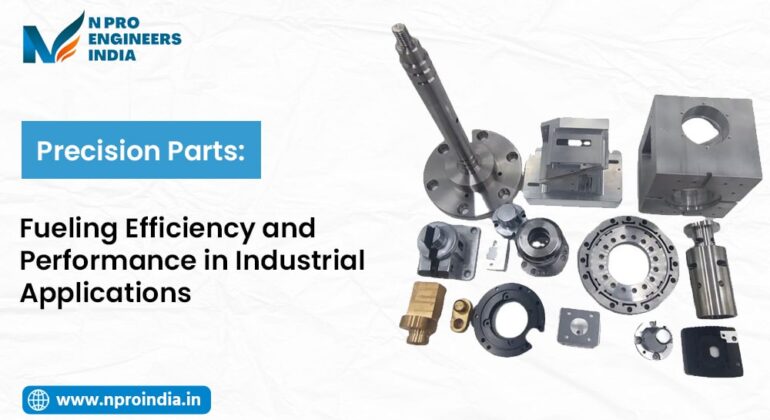

In trendy hastily evolving business panorama, precision performs a pivotal position in ensuring performance and overall performance throughout various sectors. Precision elements and additives have become necessary elements in equipment, equipment, and structures, using advancements in production, automation, etc. From aerospace and automotive to medical and electronics industries, the call for precision components keeps on leaping, shaping the future of industrial programs.
Understanding Precision Parts
Precision components, also known as precision components, are meticulously engineered additives synthetic to precise specifications with tight tolerances and excessive accuracy. These elements are crafted using superior machining techniques, consisting of CNC (Computer Numerical Control) machining, EDM (Electrical Discharge Machining), and grinding, to acquire specific dimensions and surface finishes. Precision elements are designed to suit seamlessly into complex assemblies, ensuring the most suitable functionality and performance.
Applications Across Industries
Precision components discover packages throughout a wide variety of industries, where accuracy, reliability, and consistency are paramount. In the aerospace industry, precision additives are used in plane engines, touchdown equipment systems, and avionics, where protection and reliability are important. In the automotive zone, precision components contribute to the efficiency and overall performance of engines, transmissions, and braking structures, improving the car’s overall performance and gasoline efficiency.
In the scientific field, precision parts are employed in diagnostic systems, surgical units, and prosthetic devices, permitting healthcare experts to supply accurate diagnoses and remedies. In electronics manufacturing, precision components are important for producing circuit forums, sensors, and semiconductor gadgets, ensuring the reliability and functionality of electronic devices.
Benefits of Precision Parts
The use of precision parts gives numerous benefits to industries seeking to beautify efficiency and overall performance:
- Accuracy and Consistency: Precision parts are synthetic to tight tolerances, ensuring regular overall performance and dependable operation over the years.
- Improved Efficiency: By getting rid of variability and minimizing waste, precision parts make contributions to expanded efficiency in manufacturing methods, decreasing production fees and lead times.
- Enhanced Performance: Precision components enable machinery and devices to function at peak overall performance tiers, resulting in improved productivity and product best.
- Cost-Effectiveness: Although precision parts can also require better preliminary investment, their lengthy-time period advantages, including reduced downtime and upkeep prices, lead them to a cost-effective answer for industries.
- Customization: Precision components may be custom-designed to satisfy the precise necessities of every utility, making an allowance for more flexibility and adaptability in design and functionality.
Challenges and Considerations
While precision components offer several advantages, their manufacturing, and implementation include certain challenges and concerns:
- Complex Manufacturing Processes: Manufacturing precision parts often includes complicated machining strategies and specialized systems, requiring skilled operators and advanced generation.
- Quality Control: Maintaining tremendous standards is critical in the production of precision components, necessitating rigorous first-class manipulation measures all through the production manner.
- Material Selection: The desire for materials for precision components is important, as it impacts the element’s performance, sturdiness, and compatibility with the application necessities.
- Cost of Production: The manufacturing of precision elements may be pricey, specifically for small-batch or custom-made additives, requiring careful fee evaluation and optimization strategies.
- Supply Chain Management: Managing the supply chain for precision components involves sourcing uncooked substances, coordinating with providers, and ensuring timely shipping to fulfill production schedules.
Conclusion:
Precision parts play an essential position in driving efficiency and overall performance throughout numerous business applications. From aerospace and cars to scientific and electronics industries, the call for precision components continues to develop as industries try for greater accuracy, reliability, and productivity. By leveraging superior production strategies, stringent first-class control approaches, and strategic partnerships with reliable suppliers, industries can harness the overall capability of precision parts to gasoline innovation and success in the evolving commercial panorama.
To know more about Presision Parts or to get hold of Presision Parts visit our site; Npro Engineers India.