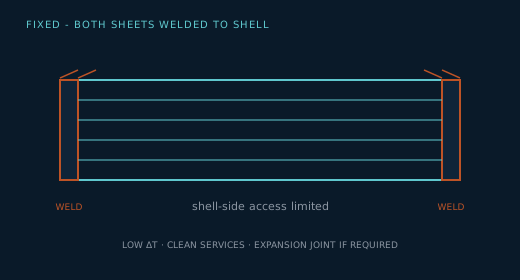
Welded directly to the shell at both ends — the simplest and most economical structural configuration, correct wherever thermal expansion between shell and tube bundle is modest.
| Structural Principle | Both ends welded rigidly to the shell — no relative axial movement |
| Typical Diameter Range | 150 mm – 3000 mm |
| Typical Thickness Range | 12 mm – 150 mm (service-dependent) |
| Thermal Expansion Handling | Requires shell-side expansion joint if ΔT is significant |
| Mechanical Cleaning Access | Tube-side only; shell-side inaccessible without cutting |
| Governing Codes | TEMA (Class R/C/B), ASME Section VIII Division 1 |
Fixed tube sheets are offered in all twelve material families — the three shown below are the most-ordered starting points.
Whenever the shell-side fluid fouls and needs periodic mechanical cleaning, or when the temperature difference between shell-side and tube-side fluids is large enough to cause significant differential expansion without an expansion joint — a floating or U-tube design is typically the better fit in either case.
Yes — individual tubes can be plugged, pulled, and replaced through the tube-side channel without removing the tube sheet itself, since it's welded permanently to the shell. This is standard maintenance practice and doesn't require cutting the shell.
There's no hard ceiling from the fixed-type design itself — the practical limit comes from plate availability, forging capacity, and the economics of the expansion joint at large diameters. Segmental construction is used beyond typical single-piece limits.
Every enquiry is checked against governing code, material compatibility and manufacturing feasibility before a quote is issued. Use our product, material, grade and standards guides to freeze the RFQ — then confirm with engineering.
Send your diameter, material, pressure class and quantity — we'll confirm thickness and price.