Product Cluster — Structural Type

Floating Tube Sheets

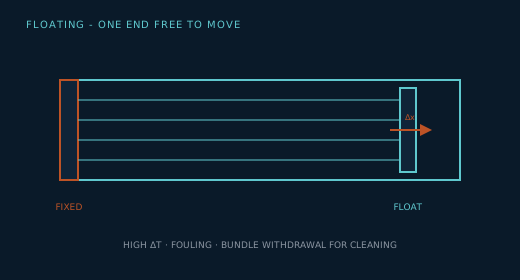
One end free to move inside the shell — built for services where thermal cycling is significant or the shell-side bundle needs to be pulled and mechanically cleaned.

Get a Quote See Specifications ↓
WELDED FLOATS → ONE END FREE — AXIAL MOVEMENT ABSORBS ΔT
DRAWINGNPRO-TS-FLT-001
AXISSTRUCTURAL TYPE
SIZE RANGE200mm – 2800mm Ø
STATUSREFERENCE / EDUCATIONAL
Specification Overview

What's fixed, and what varies by order

Structural PrincipleOne end fixed, one end free to move axially within the shell
Typical Diameter Range200 mm – 2800 mm
Typical Thickness Range15 mm – 160 mm (service-dependent)
Thermal Expansion HandlingAbsorbed by the floating head — no shell expansion joint required
Mechanical Cleaning AccessFull bundle can be pulled for cleaning on both sides
Governing CodesTEMA (Class R/C/B), ASME Section VIII Division 1
Available Materials

Every material family, this structural type

Floating tube sheets are frequently specified in corrosion-resistant grades, since the design is common in fouling or high-ΔT services.

Trade-offs

Advantages & limitations

Advantages

  • Full shell-side and tube-side mechanical cleaning access
  • No expansion joint needed regardless of ΔT
  • Bundle can be pulled without disturbing shell piping
  • Well suited to fouling or high thermal-cycling service

Limitations

  • Higher cost than fixed design due to floating head hardware
  • Lower tube density than fixed for the same shell diameter
  • More complex fabrication and longer typical lead time
  • Floating head joint requires periodic inspection
FAQ — Schema Marked

Questions about floating tube sheets

Floating designs allow both ends of every tube to be mechanically cleaned and inspected, while U-tube bundles make the inside of the bend difficult to access. Floating is generally preferred when shell-side fouling requires full mechanical cleaning access; U-tube is preferred for the highest pressure/temperature services where the floating head hardware becomes a limiting factor.

The floating head joint (packed or split-ring, depending on design) should be inspected during scheduled shutdowns for wear and seal integrity, since it's a moving mechanical joint rather than a fixed weld. This is standard practice already built into most plant maintenance schedules.

Generally yes, for the same diameter and material, due to the additional floating head hardware and more complex fabrication. The cost difference is usually justified by eliminating an expansion joint and enabling full mechanical cleaning access in services that need it.

Why Specify With NPRO India

Engineering-reviewed tube sheets — not commodity plate

Every enquiry is checked against governing code, material compatibility and manufacturing feasibility before a quote is issued. Use our product, material, grade and standards guides to freeze the RFQ — then confirm with engineering.

Tube Sheets Products Materials Grades Standards Countries We Serve Blog Calculators Get a Quote →

sales@nproindia.in  ·  +91 9594639793

Ready to Spec a Floating Tube Sheet?

Send your diameter, material, pressure class and quantity — we'll confirm thickness and price.

Get a Quote → Download Spec Sheet