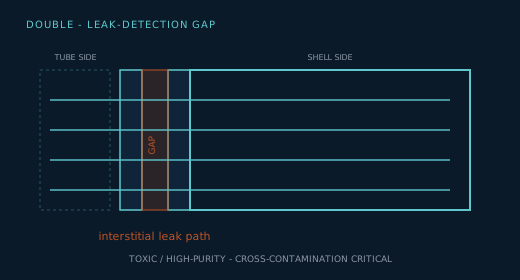
Two parallel perforated sheets create a monitored gap between tube-side and shell-side circuits — used when cross-contamination is unacceptable, such as toxic or high-purity duties. The base exchanger may still be fixed, floating or U-tube.
A double tube sheet places two sheets in series so any joint leak drains into a detectable interstitial space instead of mixing the two process fluids directly.
A double tube sheet (sometimes called dual tube sheet) uses two perforated plates separated by a small gap. Tubes pass through both sheets. If a tube-to-sheet joint leaks, the fluid enters the gap where it can be detected rather than contaminating the opposite circuit.
Double sheets are a feature layered on a structural family — fixed, floating or U-tube — not a substitute for choosing that family. Gap width, venting and monitoring details belong on the drawing and are not standardised on this page.
Start with the hub types table, then fixed, floating or U-tube for the base arrangement.
| Arrangement | Two sheets with an interstitial leak-detection gap |
| Thermal expansion | Follows the base exchanger type (fixed / floating / U-tube) |
| Primary purpose | Detect tube-joint leakage before cross-contamination |
| Typical service context | Toxic, high-purity or incompatible fluid pairs |
| Governing context | ASME / TEMA plus project contamination requirements |
Use the buyer's guide checklist, then send a drawing-led pack via the enquiry form or WhatsApp +91 95946 39793.
Two perforated sheets form a small interstitial gap. Tubes pass through both sheets so a leaking joint drains into the gap for detection instead of mixing the two process fluids.
It is a contamination-control feature applied on top of a structural family. You still choose fixed, floating or U-tube for expansion and cleanability.
When cross-contamination between tube-side and shell-side fluids is critical — for example toxic process fluids or high-purity utilities. Exact industry mandates belong on the project specification.
Gap geometry, vent/drain connections if any, hole tables for both sheets, joint methods, materials and inspection notes. Incomplete gap details delay manufacturability review.
No. Gap width and monitoring details come from the design engineer’s drawing. NPRO reviews drilling and machining feasibility against that drawing during enquiry.
Every enquiry is checked against governing code, material compatibility and manufacturing feasibility before a quote is issued. NPRO states ISO 9001 QMS and mill-test / NDT documentation practices on About — project-specific stamps or PED/CE are confirmed during enquiry, not assumed from this page.
Include both-sheet hole tables, gap notes and base structural type — we review manufacturability before quoting.