Specification Overview
What defines this classification
Size rows below are educational / application-dependent context for forged blanks — not a published NPRO capability envelope. Final diameter and thickness are confirmed against the approved drawing, forging specification and service requirements.
Forging is a blank route, not a substitute for choosing fixed, floating or U-tube architecture. For the broader tube sheet guide covering types, materials and RFQ fields, start there — then specify forged form when the drawing requires it.
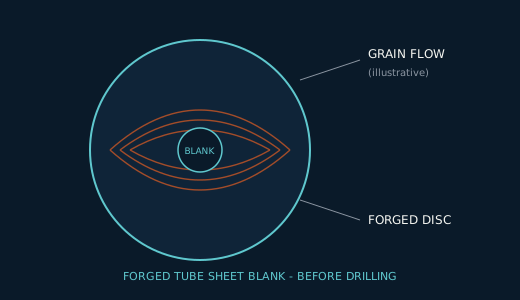
| Structural Principle | Forged blank provides directional grain flow when the forging route is specified — properties follow the applicable forging specification rather than a plate callout |
| Typical Diameter Range | Illustrative / application-dependent — ranges vary by forge practice, material and drawing. Confirm diameter against the approved drawing. |
| Typical Thickness Range | Illustrative / application-dependent — ranges vary by material, pressure class and drawing. Confirm thickness against the approved drawing and code calculation. |
| Process | Open-die forging, commonly sized closer to finished dimensions before machining when that blank route is specified |
| Governing Codes | ASME Section VIII; ASTM forged product specifications where applicable (A965 for austenitic stainless forgings; A182 for piping-component forgings; A350 for carbon/low-alloy piping forgings — confirm family) |
Specification Path
Forged Tube Sheets by Material Specification
Forging specifications define the material and product form of the blank. They are not interchangeable with plate specifications, and they do not replace TEMA or ASME design requirements for the finished tube sheet.
Stainless-steel forging path — ASTM A965 / SA-965
ASTM A965/A965M (ASME SA-965/SA-965M where applicable) covers austenitic stainless-steel forgings. F-grade designations identify the alloy within that forging specification. The first explicit NPRO discovery path:
ASTM A965 / SA-965 → F347 → SS347 / UNS S34700 → forged blank → CNC drilling → RFQ
See SS347 / F347 specification, the Standards hub material-spec section, and specification-driven CNC drilling.
Verified sibling F-grades (A965 austenitic forging path when specified — not a universal tube-sheet standard):
Nickel-alloy forging path — ASTM B564
ASTM B564 covers nickel-alloy forgings (including alloys such as N04400 and N06625 where listed). Use it when the blank is a forging — not as a substitute for plate specifications such as B127 or B443. Confirm the UNS, condition and Code context on the purchase order.