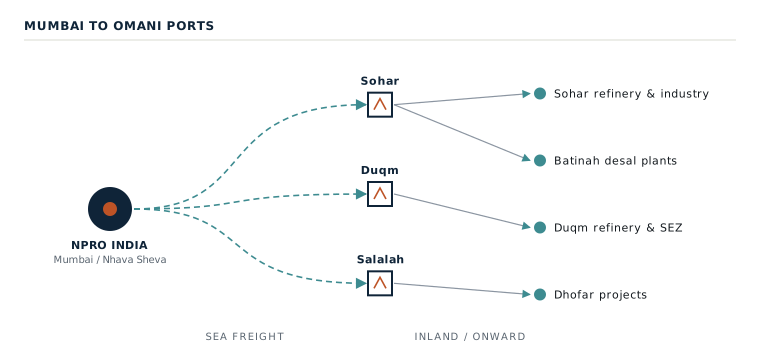
Oman's exchanger work centres on the Sohar industrial port, the Duqm refinery and special economic zone, upstream oil and gas, and a string of coastal desalination plants. We machine tube sheets to drawing and ship to Sohar, Duqm or Salalah.
Updated 28 Oct 2026
Exchanger fabricators, EPC contractors and plant operators in Oman can buy machined tube sheets from NPRO India for refinery, petrochemical, gas and desalination service. We machine to your drawing, supply ASME/TEMA records and ship to Sohar, Duqm or Salalah.
Sohar hosts a refinery, aromatics and polymer plants and an aluminium smelter around one port, so it generates both new-build and maintenance demand. Duqm adds a large refinery and a growing economic zone. Inland, upstream oil and gas fields need gas processing exchangers.
Along the coast, desalination plants supply most of the country's drinking water. Their seawater-cooled exchangers are where grade choice gets tested hardest.
Mumbai and Oman are close by sea, and Sohar is the usual entry port for industrial cargo. Duqm and Salalah are options when the project sits in the south.
| Industrial hubs | Sohar, Duqm, upstream fields |
| Ports | Sohar, Duqm, Salalah |
| Codes | ASME VIII, TEMA |
| Typical grades | Duplex, titanium, 316L, CuNi |
| PED / CE | Not usually needed |
| Enquiries | +91 9594639793 · sales@nproindia.in |
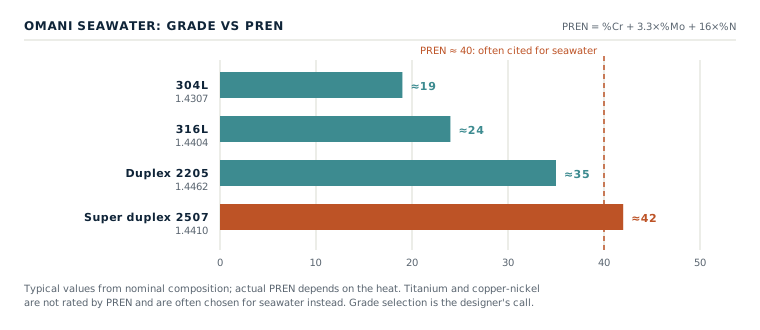
Higher PREN means better resistance to pitting in chloride water. Warm Gulf seawater is why many local drawings skip 316L and start at duplex. Titanium and copper-nickel sit outside this scale and are common seawater choices too.
Process exchangers, often in stainless or duplex, with replacement sheets ordered at turnarounds.
Seawater-cooled condensers and heaters where pitting and crevice corrosion decide the grade.
Gas plant coolers and exchangers, some in sour service with hardness limits.
Arabian Sea and Gulf of Oman seawater is warm and chloride-rich, which is hard on stainless steel. The tube sheet also has to be compatible with the tube material, or galvanic corrosion starts at the joint. These are the usual options, not a substitute for your materials engineer's choice.
| Grade | Seawater suitability | Watch out for |
|---|---|---|
| 316L | Limited in warm seawater | Pitting and crevice corrosion at the tube joint |
| Duplex 2205 | Good for many cooling duties | Temperature and chloride limits |
| Super duplex 2507 | Better margin in warm seawater | Welding and heat treatment control |
| Titanium Gr. 2 | Excellent | Matching titanium tubes and joint method |
| CuNi 90/10 | Proven in condensers | Flow velocity and polluted water |
See duplex vs super duplex and marine-grade stainless for more.
Desalination plants run continuously and plan outages carefully, so replacement tube sheets need to be ready when the unit is opened. The usual triggers are pitting or crevice corrosion around the tube holes, and erosion at the inlet end.
If the old sheet corroded early, that's a sign to review the grade. A move from 316L to duplex, or from duplex to super duplex or titanium, is common. The decision belongs to the plant's materials engineer; we quote both options if you ask.
The drawing or a survey, the tube material, and the water conditions (temperature, chlorides). See tube sheets in the desalination cycle.
Sohar is the usual port for industrial cargo. Duqm and Salalah are options for projects in the south. Muscat's Port Sultan Qaboos no longer handles commercial cargo.
It depends on temperature, chlorides and the tube material. Duplex, super duplex, titanium and copper-nickel are the usual candidates; the table above shows the trade-offs, and your materials engineer makes the call.
Yes. Send the drawing or a measured survey of the old sheet, plus the turnaround date, and we tell you whether it can be made in time before you commit.
Send drawing, grade, quantity and port via the enquiry form or to sales@nproindia.in.
Drawing, grade, service and port (Sohar, Duqm or Salalah). We review it before quoting.
Get an Export Quote →