Responsibilities
Where the tube sheet sits in a CRN file
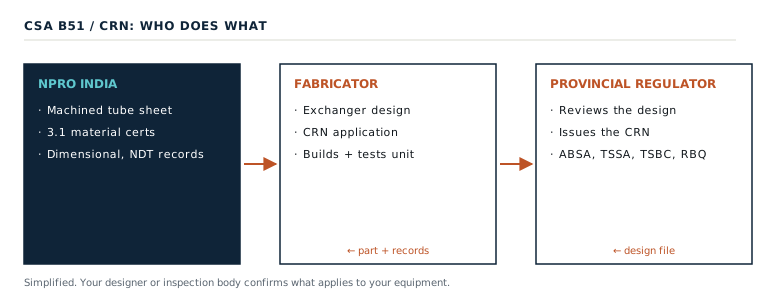
Nothing on the tube sheet changes after registration without the fabricator's say-so. That's why we quote one drawing revision and ask before substituting anything.
Tube sheets machined to your drawing for exchangers that will be registered under CSA B51. The CRN belongs to your fabricator's design; our job is a part that matches it, with material records the registration reviewer will want to see.
Updated 28 Oct 2026
In Canada the exchanger design gets a Canadian Registration Number (CRN) from the provincial authority, under CSA B51. The tube sheet is part of that registered design, so it has to match the drawing exactly and arrive with traceable material certificates. NPRO India supplies the machined part and its records; the fabricator holds the CRN.
Canadian enquiries tend to come from fabricators in Alberta and Ontario building exchangers for oil sands and upgrading, mining and minerals processing and power generation, with pulp and paper mills as a steady replacement market.
Because the design is registered, changes are expensive. A hole pattern that drifts from the registered drawing, or a material substitution, can send the design back to the regulator. That's why we treat the drawing revision as fixed and ask questions before we cut metal.
Canadian shops use both tube sheet and tubesheet, and often mix metric drawings with imperial tube sizes. Both are fine for quoting.
| Design code context | ASME VIII Div. 1, adopted through CSA B51 |
| Design registration | CRN, issued per province |
| Who registers | The exchanger fabricator / designer |
| Our scope | Machined tube sheet + material and inspection records |
| Ports | Vancouver, Montreal, Halifax |
| Enquiries | +91 9594639793 · sales@nproindia.in |
Nothing on the tube sheet changes after registration without the fabricator's say-so. That's why we quote one drawing revision and ask before substituting anything.
The CRN is issued by the jurisdiction where the equipment will be used. These are the regulators Canadian fabricators most often deal with. A tube sheet supplier doesn't apply to them directly, but knowing who reviews the file helps you decide which records to ask for.
| Province | Regulator | What it means for the tube sheet |
|---|---|---|
| Alberta | ABSA (Alberta Boilers Safety Association) | Oil sands exchangers; expect close scrutiny of material traceability |
| Ontario | TSSA (Technical Standards and Safety Authority) | Process and power exchangers; drawing revision must match the registered design |
| British Columbia | Technical Safety BC | Pulp, mining and LNG-related equipment |
| Quebec | RBQ (Régie du bâtiment du Québec) | Documents may be needed in French for the end user |
Requirements differ by province and change over time. Your fabricator's registration specialist has the final word on what the file needs.
Hot, abrasive and sometimes sour service. Grade and joint method matter more than usual, and replacement sheets are common at turnarounds.
Condenser and feedwater heater tube sheets, often thick, where hole drift on deep drilling is the main machining risk.
Evaporator and heater tube sheets in stainless and duplex, frequently ordered as like-for-like replacements.
| Record | What to specify |
|---|---|
| Mill test certificate | ASME SA/SB designation and the certificate type, e.g. EN 10204 3.1 |
| Heat number traceability | Marked on the sheet and on the certificate, so the reviewer can match them |
| Dimensional report | Hole positions, diameters, groove dimensions against the drawing revision |
| NDT records | UT of the plate or forging if your design calls for it; PMI on alloy grades |
| Language | English by default; ask early if Quebec projects need French copies |
More on inspection in testing & quality. If your registration reviewer asks for something not listed here, send the request; we confirm whether we can provide it before you order.
Also see titanium Grade 2, Monel 400, the tube sheet guide and floating tube sheets for high temperature-difference service.
We quote against one drawing revision, the one in your CRN file. If the design changes during registration, send the new revision before we order material.
Some fabricators like to see the proposed mill certificate before machining starts, so their registration file stays consistent. Ask for it and we send it for review.
Drilling, grooving and facing to the drawing, followed by the dimensional check and any NDT you specified. Records go to you with the shipment and electronically beforehand.
Vancouver is the usual port for Alberta-bound sheets, with rail or truck inland; Montreal or Halifax for the east. Your broker handles customs entry, and we provide the commercial invoice and packing list in the format they need.
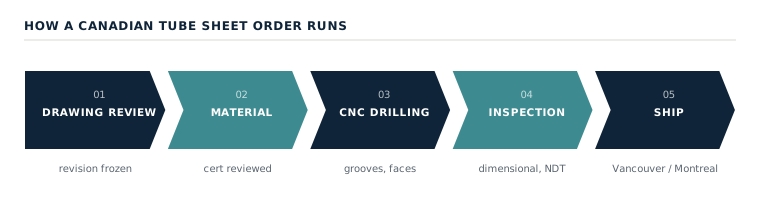
The mill certificate can be reviewed by your registration specialist before machining starts, so the file stays consistent.
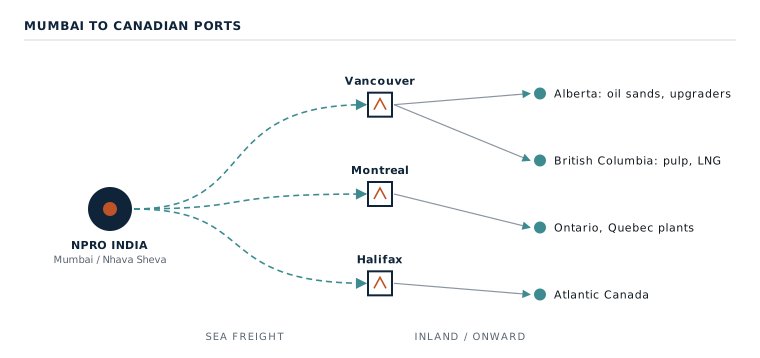
Rail or truck inland from the port; your broker handles customs entry.
No. The CRN is registered by the fabricator or designer of the exchanger with the provincial regulator. We supply the tube sheet machined to the registered drawing, with the material and inspection records the file needs.
Tell us the SA or SB specification and grade on the drawing and the certificate type you need. We confirm the available material and its certification with the quote, so there's no substitution later.
Yes. Mixed units are common on Canadian drawings. We quote from tube OD, gauge and pitch as given, and flag anything ambiguous.
Vancouver for western Canada and Alberta-bound freight, Montreal or Halifax for the east. Your forwarder can take it from the port, or ask for a DAP quote.
Use the enquiry form with the drawing revision, grade, quantity and destination province, or email sales@nproindia.in.
Send the drawing revision, grade, quantity and destination province. We check it against the drawing before quoting.
Get an Export Quote →