Foratura profonda
Why thick sheets get extra checking
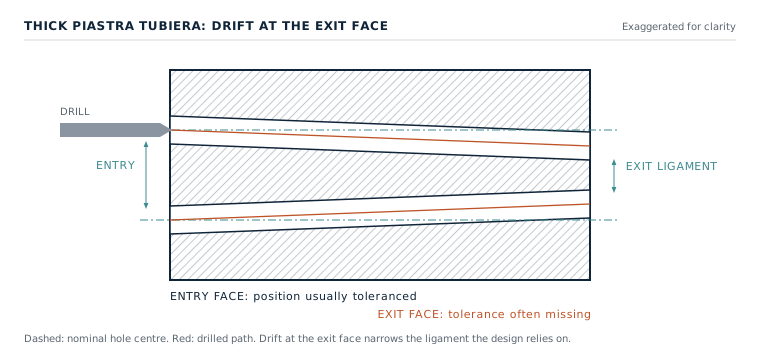
Italian fabricators building for overseas EPCs often specify thick sheets with tight hole positions. Drift is the risk we price in and measure.
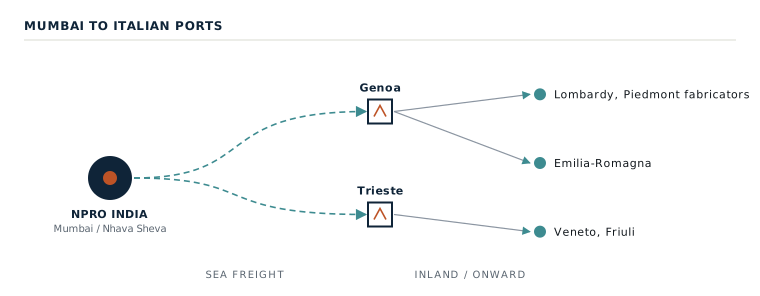
Italy has one of Europe's largest heat exchanger fabrication bases, much of it in the north and much of it building for export. Italian drawings call the part a piastra tubiera. We machine to those drawings and ship via Genoa or Trieste.
Updated 28 Oct 2026
Italian heat exchanger fabricators can buy machined tube sheets (piastre tubiere) from NPRO India to their drawing. Because many Italian units are built for oil and gas projects abroad, drawings often carry ASME materials as well as EN grades; we quote against exactly what the drawing specifies.
Much of our Italian interest comes from fabricators building exchangers for oil and gas and petrochemical projects in the Middle East, Africa and Asia, plus chemical plants at home and marine builders who need seawater-resistant tube sheets.
That export focus shapes the drawing. A single Italian order might carry an ASME SA-240 material, a TEMA class, a PED-based documentation package and an end-user specification from a foreign EPC. Our review starts with lining those up, so the certificates you receive work for every inspector on the job.
Italian buyers often need thick, large-diameter sheets with tight hole positions. Deep-hole drilling accuracy is where we spend our checking time.
| Italian term | Piastra tubiera |
| Design codes seen | EN 13445, ASME VIII, TEMA |
| Directive | PED 2014/68/EU (finished equipment) |
| Certificates | EN 10204 3.1 |
| Ports | Genoa, Trieste |
| Enquiries | +91 9594639793 · sales@nproindia.in |
Italian fabricators building for overseas EPCs often specify thick sheets with tight hole positions. Drift is the risk we price in and measure.
A typical export-project drawing from an Italian fabricator. These are the points we confirm before quoting, so the paperwork satisfies the fabricator, the EPC and the end user.
| Item on the drawing | What we check |
|---|---|
| ASME material (e.g. SA-240 316L) with EN reference | That the mill certificate can carry both designations if required |
| TEMA class R, C or B | Tube hole tolerances and grooving for that class |
| End-user specification from the EPC | Extra PMI, UT or hardness requirements beyond the code |
| Certificate type | 3.1 as standard; 3.2 needs a witness booked in advance |
| Marking | Heat number and drawing number position on the sheet |
Italian export units are often large, high-pressure exchangers, which means thick tube sheets and long holes. On a thick sheet the drill can wander as it goes deeper, so a hole that's on position at the entry face can be off at the exit face. That's what eats into the ligament, and it's what inspectors measure.
Plate thickness against tube OD, the pitch, and the tolerance on hole position at both faces. If the drawing only gives an entry-face tolerance, we ask whether the exit face matters for your tube insertion and expansion.
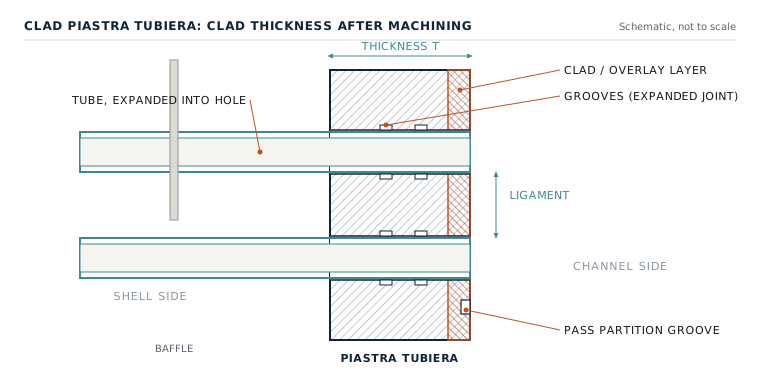
For clad tube sheets we also confirm the clad thickness after machining, because facing and grooving remove material from the cladding. Our clad vs solid guide explains when a clad sheet makes sense.
Also: clad tube sheets, large diameter tube sheets and CNC drilling.
We read the drawing, the fabricator's specification and the EPC or end-user specification together, and list any conflicts in our first reply rather than after the order.
If the EPC's inspector will witness, the hold points go into the plan before material arrives.
Drilling, grooving and facing to the drawing, with dimensional, PMI and NDT records against the agreed plan.
Crated by sea to the nominated port; Incoterms and consignee agreed at order.
Where the material is dual-certified by the mill, yes. Tell us which designations must appear and we confirm it with the quote.
Send the diameter and thickness. Large thick sheets are mainly a deep-drilling accuracy question, which we review against your hole tolerances. See large diameter tube sheets.
The manufacturer of the finished exchanger. We supply the tube sheet and its material and inspection records.
Genoa or Trieste, or the port your forwarder nominates. Incoterms are agreed at order.
Drawing, grade, certificate type, end-user spec and delivery port. We review it before quoting.
Get an Export Quote →