NPRO Journal · MATERIALS
Copper-Nickel and Inconel 625
Tube Sheets
Specifier notes on when Cu-Ni 90/10, Cu-Ni 70/30 or Inconel 625 belong on a tube-sheet RFQ — and what must be frozen before manufacture.
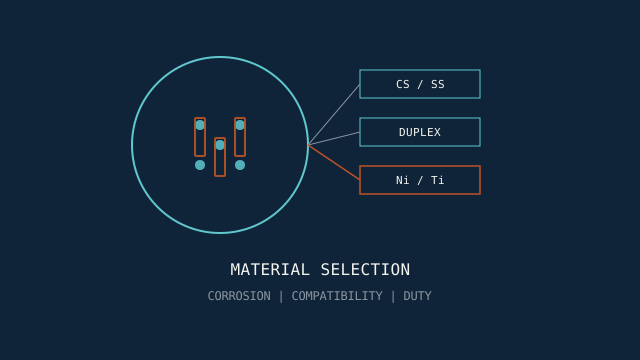
Specifier notes on when Cu-Ni 90/10, Cu-Ni 70/30 or Inconel 625 belong on a tube-sheet RFQ — and what must be frozen before manufacture.
Alloy name alone does not specify a tube sheet. When a drawing calls for copper-nickel or Inconel 625, the real work is matching process fluid, temperature, mechanical demand, tube compatibility and project specification — then locking those decisions into an RFQ a fabricator can machine and document.
This article is for engineers, EPC writers and procurement teams who specify tube sheets used in shell-and-tube heat exchangers and condensers. NPRO India manufactures and exports tube sheets; equipment such as condensers and heat exchangers appears here only as application context, not as products NPRO claims to build as complete units. Commercial material destinations live on the copper-nickel and Inconel 625 pages; this journal owns the selection and specification questions that sit in front of that RFQ.
Copper-nickel is a family, not one grade. Inconel 625 is one nickel-chromium-molybdenum alloy (UNS N06625), not a shorthand for every nickel alloy. Treat them as different material decisions with overlapping but non-identical selection logic.
The tube sheet is both a structural member and the interface between tubes, channel/shell hardware and the process environment. Material choice affects corrosion behaviour on the wetted face, galvanic interaction with the tube alloy, allowable stress for thickness calculation, machining behaviour during hole drilling, and the documentation pack purchasers expect on delivery.
Selection must be evaluated against the project specification, governing design code and actual service conditions. Substituting “equivalent” alloys without written engineering approval is a common procurement failure mode — and one that rarely survives client audit.
Practical factors that usually move together:
For a broader checklist across stainless, duplex, clad and exotic options, see how to select tube sheet material and the materials hub.
Copper-nickel tube sheets are frequently considered for seawater and brackish cooling service, marine condensers and related heat-transfer duty where biofouling resistance and general seawater corrosion performance matter. They are often more economical than titanium for standard seawater cooling, but velocity, temperature, contaminants and chemistry still govern whether Cu-Ni is adequate.
Suitability depends on alloy grade, product form, flow conditions, oxygenation, local fouling severity and the written purchaser specification. “Copper-nickel for seawater” is a starting hypothesis, not a finished material callout.
Two commercial grades dominate tube-sheet RFQs in this family: Cu-Ni 90/10 and Cu-Ni 70/30.
These grades share a copper-nickel family identity but are not interchangeable procurement callouts.
Cu-Ni 90/10 (UNS C70600) is the common default for general seawater and brackish cooling at moderate flow velocity. Nominal nickel content is about 10% (grade datasheets typically specify a 9.0–11.0% nickel window). Exact chemistry limits belong to the applicable material standard and purchase order — freeze the UNS and product specification rather than relying on the “90/10” nickname alone.
90/10 is not automatically adequate for every seawater condenser. Erosion-corrosion risk rises with velocity and turbulence; sand loading and biofouling severity still require engineering review.
Cu-Ni 70/30 (UNS C71500) increases nickel relative to 90/10 (datasheets commonly place nickel in a higher band around 29–33%). It is often evaluated where flow velocity, erosion-corrosion exposure or biofouling conditions are more severe than the 90/10 envelope, while remaining within copper-nickel practice rather than jumping immediately to titanium or nickel alloys.
Practical service-temperature guidance on NPRO grade pages places copper-nickel well below the high-temperature envelope associated with Inconel 625. Do not treat Cu-Ni as a high-temperature process alloy simply because nickel appears in the name.
Inconel 625 (UNS N06625) is a nickel-chromium-molybdenum alloy with niobium strengthening. On NPRO’s grade page it is positioned for corrosive and high-temperature heat-exchanger duty, with ASTM product-form references such as B446 / B564 commonly appearing on material callouts. Exact edition and product form must follow the purchase specification.
625 is not a copper-nickel “upgrade path.” It is a different material family with a different cost, machining and documentation profile.
625 tends to enter the conversation when:
If temperature and chemistry sit comfortably inside stainless, duplex or copper-nickel practice, 625 can be an expensive over-specification. Selecting Cu-Ni for a high-temperature process face because it “contains nickel” is a category error. Evaluate against the project specification.
Procurement teams writing export RFQs for process duty — including programmes destined for the United States — should treat grade, product form and documentation scope as explicit line items, not assumptions carried over from carbon-steel or stainless jobs.
Neither family is universally superior. The useful comparison is which selection rationale matches the duty.
| Consideration | Copper-nickel (90/10 / 70/30) | Inconel 625 (UNS N06625) |
|---|---|---|
| Alloy family | Cu-Ni alloys (e.g. UNS C70600 / C71500) | Ni-Cr-Mo (+Nb) nickel alloy |
| Typical engineering context | Seawater / brackish cooling; marine condenser economics | Aggressive chemistry and/or elevated-temperature process duty |
| Seawater / marine relevance | Strong traditional fit for condenser cooling service | Not selected merely for seawater; chemistry/temperature driven |
| Corrosion considerations | General seawater resistance; velocity & fouling still matter | Broad corrosion resistance in demanding process environments (project-specific) |
| Temperature considerations | Typically moderate-temperature cooling duty | Much higher practical temperature envelope than Cu-Ni |
| Mechanical considerations | Different strength and machining behaviour than Ni alloys | Higher strength; machining and tooling differ from Cu-Ni |
| Relative material-cost consideration | Usually lower cost than nickel alloys for seawater cooling duty | Premium alloy — justify against written duty, not habit |
| Fabrication / specification | Freeze 90/10 vs 70/30 + UNS + product form | Freeze UNS N06625 + product form + applicable ASTM callouts |
| When further review is needed | High velocity, unusual chemistry, or borderline temperature | Need vs stainless/duplex/Cu-Ni alternatives; stock and documentation scope |
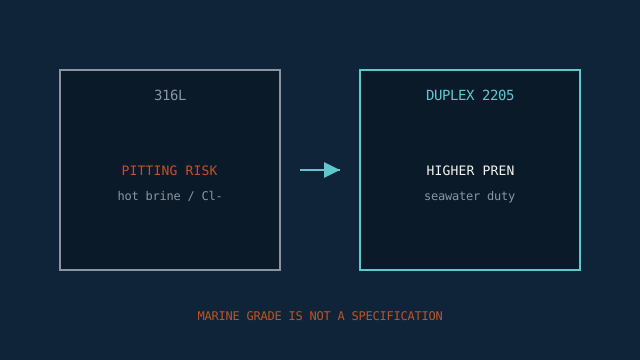
Material selection is service-specific. Related reading when “marine grade” stainless is being debated instead of Cu-Ni: when marine-grade stainless is not enough.
A tube sheet should not be selected in isolation. Tube alloy, sheet alloy, joint method and cleaning environment form one package.
Review together:
A seawater condenser that pairs copper-nickel tubes with a mismatched tube-sheet alloy can create galvanic cells, joint difficulties or documentation conflicts that only appear after fabrication quotes are compared. For joint-method context, see expanded vs welded joints.
Clad construction (corrosion-resistant face on a structural backing) is a separate decision from solid Cu-Ni or solid 625. If cladding is allowed, minimum clad thickness, cladding UNS and bond inspection must appear on the RFQ — see clad vs solid tube sheets.
Condensers and seawater-related cooling systems often create demanding material-selection requirements because chloride exposure, flow velocity, biofouling and cleaning practice interact. That does not mean every condenser tube sheet must be copper-nickel — or that copper-nickel is always enough.
Factors that typically appear in engineering review:
NPRO manufactures condenser tube sheets as tube-sheet products for use in condenser equipment — not complete condensers. For desalination brine chemistry as a driver of material upgrades over a plant life, see desalination replacement cycles. Gulf Coast and GCC cooling programmes — including work destined for the UAE, Saudi Arabia or Oman — still need project-specific chemistry and velocity data on the RFQ, not country keywords.
Use this as a working checklist. The final list depends on the project specification.
Structural type still matters: fixed, floating or U-tube geometry should be frozen alongside grade, not after the PO.
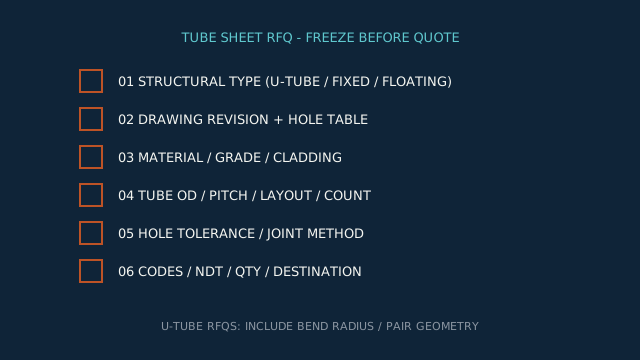
Incomplete RFQs produce incomparable quotes — or optimistic ones that reopen when grade identity and documentation are clarified. Project specification governs; use the list below as a completeness check.
For drilling accuracy and pattern context, see CNC tube sheet drilling. For procurement patterns that delay quotes, see RFQ mistakes and ten questions before ordering. Share a drawing-led package through the enquiry form.
Export packing and witness points can differ by destination — including programmes routed through hubs such as Singapore. State destination on the RFQ so ex-works and landed dates are not confused.
Align documentation with the standards baseline and client inspection plan — not with informal “same as last time” language.
NPRO India manufactures and supplies tube sheets, including copper-nickel and Inconel 625 grades listed on the site’s material and grade pages. Work is drawing-led: grade, geometry, code references and documentation scope belong on the RFQ so manufacturability can be reviewed before quotation.
Start from the commercial pages that match your callout — copper-nickel, 90/10, 70/30, Inconel 625 — and the tube sheets hub for structural types. Then send the drawing package through enquiry.
A tube sheet manufactured from a copper-nickel alloy — commonly Cu-Ni 90/10 (UNS C70600) or Cu-Ni 70/30 (UNS C71500) — typically considered for seawater or brackish cooling and related condenser service. See the copper-nickel material page.
Nickel content and the associated service envelope. They are related alloys, not interchangeable callouts. Freeze the UNS grade on the RFQ.
A nickel-chromium-molybdenum alloy commonly identified as UNS N06625, considered for demanding corrosive and elevated-temperature tube-sheet duty when the project specification requires that performance level. See Inconel 625.
Often considered for seawater and marine condenser cooling, but suitability depends on grade, velocity, chemistry, fouling and the purchaser specification. It is not universal.
No. “Better” only exists relative to a defined duty. 625 is a different family with different cost and capability.
Map fluids, temperature, pressure, tube alloy, joint method and code requirements; then freeze an exact UNS grade and product form. Use the checklists above.
They need not be identical alloys, but they must be reviewed together for corrosion compatibility, galvanic risk and joint method.
Drawing revision, exact grade/UNS, dimensions, hole pattern, tube material, joint method, service summary, design conditions, codes, inspection scope, quantity and destination.
Yes — NPRO’s website lists copper-nickel (including 90/10 and 70/30) and Inconel 625 tube-sheet material pages for drawing-led quotation. Capability for a specific size, form and documentation pack is confirmed against your drawing and RFQ.
Copper-nickel (90/10 and 70/30) and Inconel 625 solve different problems. Cu-Ni remains a primary conversation for seawater and marine condenser tube sheets; 625 enters when process severity and temperature justify a nickel alloy. Freeze UNS grade, tube compatibility, geometry and documentation before asking for price.
Have a tube-sheet material requirement? Share your drawing, material specification and service details with NPRO for review via the enquiry form — or email sales@nproindia.in / call +91 9594639793.
Have a tube-sheet material requirement? Share your drawing, material specification and service details with NPRO for review.
Send an Enquiry →