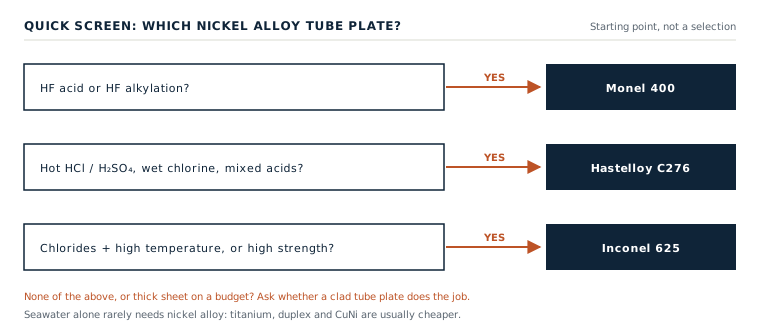
- Monel 400 is the classic choice for hydrofluoric acid and caustic; Hastelloy C276 for hot reducing and mixed acids and wet chlorine; Inconel 625 for chlorides at high temperature and strength.
- Plate specs on ASME drawings: SB-575 (C276), SB-443 (625), SB-127 (Monel 400); forgings under SB-564; clad plate under SA-265.
- For a Ø1000 × 80 mm blank, solid C276 needs about 559 kg of alloy; a 5 mm clad face needs about 35 kg.
- For plain seawater, titanium, duplex or copper-nickel is usually cheaper than any nickel alloy.
The short answer
Pick the nickel alloy by the chemistry on the wetted face, not by reputation. Monel 400 (UNS N04400) is the standard for HF alkylation units and hot caustic. Hastelloy C276 (UNS N10276) handles hot hydrochloric and sulfuric acid, wet chlorine and mixed, poorly characterised streams. Inconel 625 (UNS N06625) combines strong chloride pitting resistance with high-temperature strength. When the plate is thick, a clad tube plate with a nickel-alloy face is often the economical way to get the same corrosion resistance.
What's in each alloy
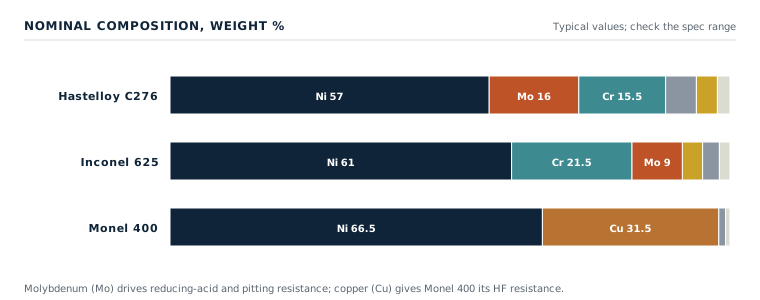
The chemistry explains the behaviour. C276's 16% molybdenum gives it resistance to reducing acids and pitting; its chromium handles oxidising conditions, so it copes with mixtures. Inconel 625 trades some molybdenum for more chromium plus niobium, which adds strength and oxidation resistance at temperature. Monel 400 is nickel and copper, and that copper is why it does so well in HF and so poorly in oxidising acids such as nitric.
Which service suits which alloy
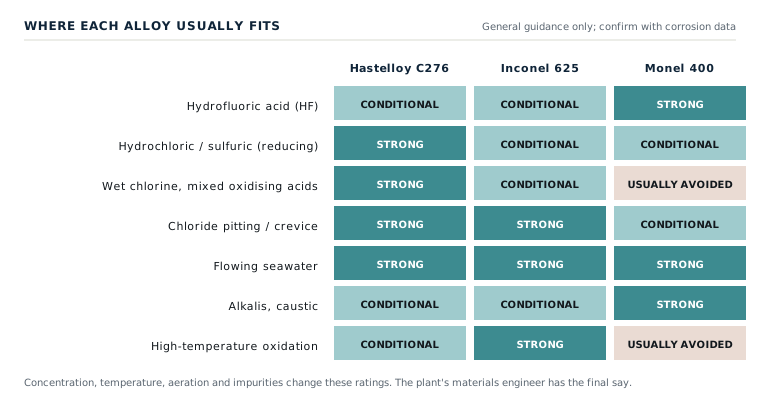
- Refinery HF alkylation: Monel 400 tube sheets and tubes are the long-established pairing.
- Chemical plants with acid streams: C276 where the stream is hot, reducing or variable. See chemical processing.
- Sour, chloride-rich process streams at temperature: Inconel 625, often as cladding on a steel tube plate.
- Wet chlorine and chlorine dioxide: C276 (or C22) rather than Monel.
Specs to put on the drawing
| Hastelloy C276 | Inconel 625 | Monel 400 | |
|---|---|---|---|
| UNS | N10276 | N06625 | N04400 |
| EN number | 2.4819 | 2.4856 | 2.4360 |
| ASME plate spec | SB-575 | SB-443 | SB-127 |
| ASME forging spec | SB-564 | SB-564 | SB-564 |
| Clad plate spec | SA-265 (on steel base) | SA-265 (on steel base) | SA-265 (on steel base) |
| Density, g/cm³ | 8.89 | 8.44 | 8.80 |
| Datasheet | C276 | Inconel 625 | Monel 400 |
State the product form as well as the grade: plate, forging, or clad plate with the base metal named. Thick tube sheets in nickel alloy are often specified as forgings; large, moderately thick ones as clad plate. Cross-references to other systems are in the grade equivalence table.
Solid or clad: where the money goes
Nickel alloys cost many times more per kilogram than carbon steel, so the question on a thick tube plate is how much alloy you actually need. Corrosion happens on the wetted face, and a clad plate puts the alloy only there.
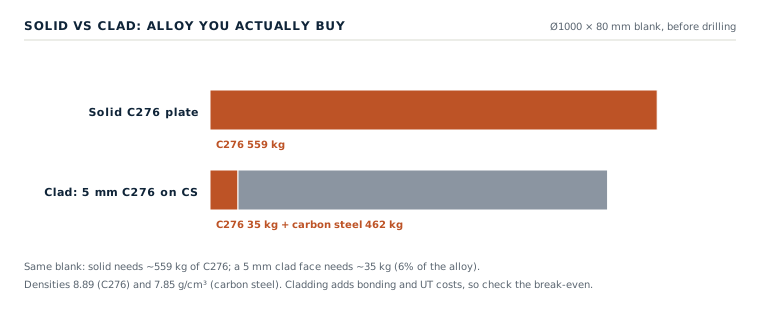
In that example the clad face uses about 6% of the alloy. Cladding brings its own costs (explosion or weld-overlay bonding, bond UT, a longer route), so it pays off as thickness and diameter grow. Thin, small tube plates are often cheaper solid. We look at the break-even in clad vs solid tube sheets, and the product options on clad tube sheets.
Machining nickel alloy tube plates
All three alloys work-harden, and C276 and 625 are tough to cut. In practice that means slower drilling, sharper tooling and careful control of hole finish and size, which shows up in lead time more than in tolerance. Deep holes in thick nickel-alloy plates are where hole drift and tool wear need the most attention; our CNC drilling process plans for both. For hole tolerances, see how to read a tube sheet drawing.
Tube-to-tubesheet joints in nickel alloys
Nickel alloy tube sheets are usually paired with tubes of the same or a compatible alloy, and the joint is often expanded and seal-welded, or strength-welded, because leak tightness matters in these services. That has three consequences for the tube plate:
- Weld preparation at each hole must be on the drawing, with the filler metal stated (for example ERNiCrMo-4 for C276, ERNiCrMo-3 for 625, ERNiCu-7 for Monel 400).
- Hole finish and size matter more, because work-hardened material expands less forgivingly. See expanded vs welded joints.
- On clad tube plates, the weld sits in the clad layer, so the clad must be thick enough to contain it after machining.
Certificates and inspection to ask for
- EN 10204 3.1 mill certificate for the plate or forging, with heat number traceable to the marking on the tube sheet.
- PMI (positive material identification) of the finished tube sheet, since nickel alloys look alike once machined.
- Ultrasonic testing of the plate or forging, and of the bond on clad plate (SA-578 is commonly referenced).
- Dimensional report covering hole diameter, pitch and ligament against the drawing revision.
- Third-party (3.2) witness where the project specification calls for it.
Our testing and inspection page lists what we can provide.
A quick screen
When you don't need a nickel alloy
Seawater on its own is the most common case of over-specification. Titanium Grade 2, duplex or super duplex and copper-nickel usually handle it at lower cost; see titanium, duplex 2205 and our notes on copper-nickel and Inconel 625 tube sheets. For a head-to-head of two of these alloys, see Monel 400 vs Inconel 625. US buyers sourcing exotic tube sheets from India will find logistics notes on our USA page.
Frequently asked questions
Neither is better overall. Hastelloy C276 is usually chosen for hot reducing and mixed acids and wet chlorine; Inconel 625 for chlorides at high temperature and where strength matters. The process chemistry decides.
Its nickel-copper chemistry gives good resistance to hydrofluoric acid across a wide range of conditions, which is why Monel 400 tube sheets and tubes are a long-established choice in HF units.
SB-575 covers C276 plate, sheet and strip. Forgings fall under SB-564, and nickel-alloy-clad steel plate under SA-265.
On the wetted face, yes, provided the clad layer is thick enough after machining and the bond is verified by UT. The steel base carries the pressure load.
Usually not. Titanium, duplex or super duplex and copper-nickel normally cover seawater service at lower cost.
Sources and further reading
- ASME BPVC Section II Part B: SB-127, SB-443, SB-564, SB-575
- ASME BPVC Section II Part A: SA-265 (nickel and nickel-base alloy clad steel plate)
- Producer datasheets for UNS N10276, N06625 and N04400 (nominal composition and density)