- TEMA stands for the Tubular Exchanger Manufacturers Association; its standards define the three-letter type code.
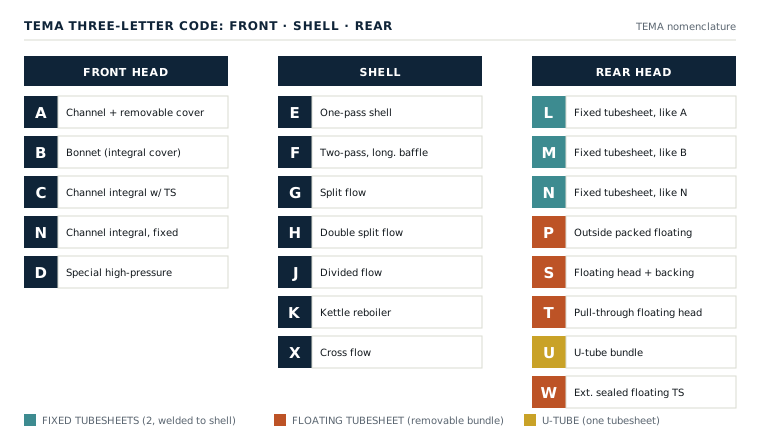
- Letter 1 is the front head, letter 2 the shell, letter 3 the rear head. The rear head letter decides the tube sheet design.
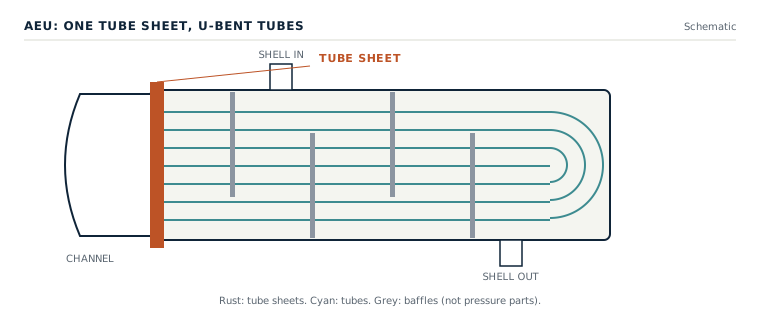
- L, M and N rear heads mean two fixed tube sheets; P, S, T and W mean a floating tube sheet; U means one tube sheet.
- TEMA type (AES) and TEMA class (R, C, B) are different things; drawings usually state both.
TEMA: full form and what the code is for
TEMA is the Tubular Exchanger Manufacturers Association. Its standards cover the mechanical design, tolerances and nomenclature of shell-and-tube heat exchangers, and they sit alongside the pressure vessel code (usually ASME Section VIII) rather than replacing it. The part almost everyone meets first is the three-letter type designation.
Decoding a type: AES as an example
Read the letters left to right, from the channel end to the far end of the shell.
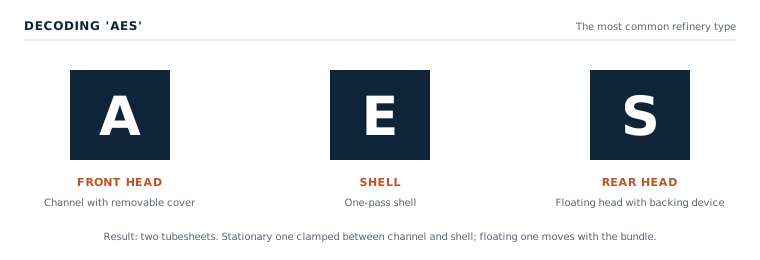
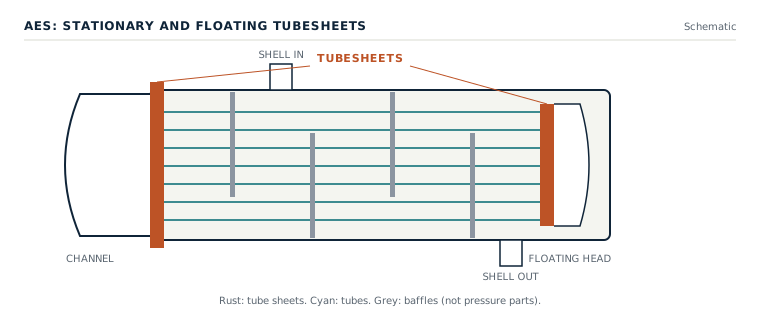
An AES exchanger therefore has two tube sheets. The stationary tube sheet is clamped between the channel and the shell flange; the floating tube sheet moves with the tubes as they expand, sealed inside the shell cover. The bundle can be pulled for cleaning, which is why AES is so common in refinery service.
The front, shell and rear head letters
Front heads
| Letter | Front head | Tube sheet note |
|---|---|---|
| A | Channel with removable cover | Tube sheet gasketed to the channel; tube ends accessible without removing piping |
| B | Bonnet (integral cover) | Cheaper; piping or bonnet must come off to reach the tube sheet |
| C | Channel integral with tube sheet, removable cover | Tube sheet welded to the channel; bundle still removable |
| N | Channel integral with tube sheet, non-removable | Tube sheet welded to both channel and shell |
| D | Special high-pressure closure | Thick tube sheets; used on high-pressure feedwater heaters |
Shells
E is the one-pass shell and by far the most common. F adds a longitudinal baffle for two shell passes; G and H are split flow; J is divided flow, used to cut pressure drop; K is the kettle reboiler with its enlarged shell; X is cross flow. The shell letter changes the baffle and nozzle layout more than the tube sheet itself, though a K shell's bundle is usually small relative to its shell.
Rear heads: where the tube sheet design is decided
| Letter | Rear head | Tube sheets | Bundle removable? |
|---|---|---|---|
| L | Fixed tube sheet, like A stationary head | 2 fixed | No |
| M | Fixed tube sheet, like B stationary head | 2 fixed | No |
| N | Fixed tube sheet, like N stationary head | 2 fixed | No |
| P | Outside packed floating head | 1 stationary + 1 floating | Yes |
| S | Floating head with backing device | 1 stationary + 1 floating | Yes |
| T | Pull-through floating head | 1 stationary + 1 floating | Yes, without removing the shell cover |
| U | U-tube bundle | 1 | Yes |
| W | Externally sealed floating tube sheet | 1 stationary + 1 floating | Yes |
Common types and their tube sheets
| Type | Typical use | Tube sheets | What the tube sheet drawing must show |
|---|---|---|---|
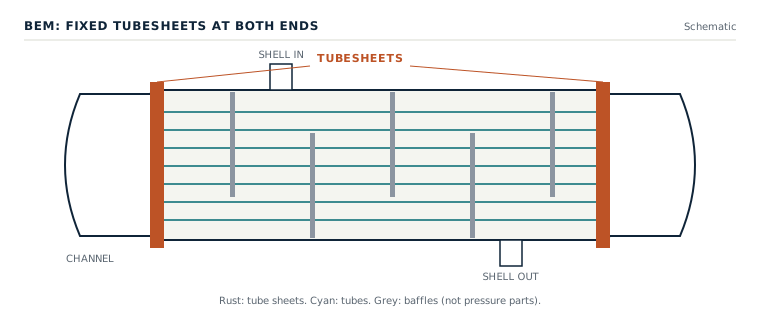
| BEM | Clean services, small ΔT | 2 fixed | Shell weld preparation at both tube sheets; expansion joint if ΔT is high |
| NEN | High-pressure, clean, compact | 2 fixed, integral | Weld preps to both shell and channel |
| AES | Refinery service, fouling shell side | Stationary + floating | Floating tube sheet OD, backing-ring groove, gasket faces |
| AET | Frequent bundle pulls | Stationary + floating | Floating tube sheet with bolted cover; larger OTL clearance |
| AEU / BEU | High pressure or high ΔT | 1 | Tube plate thickness for full pressure; U-bend zone |
| AKT / BKU | Kettle reboilers | 1 or 2 | Small bundle in a large shell; pull-through or U-tube |
For product detail see fixed, floating and U-tube tube sheets, and our comparison of fixed vs floating designs. If you need a removable-bundle exchanger, any P, S, T, U or W rear head gives you one; the fixed L, M and N types do not.
How engineers choose between fixed, floating and U-tube
The type usually falls out of three questions about the process:
- Does the shell side foul? If it needs mechanical cleaning, the bundle must come out, which rules out L, M and N rear heads.
- How big is the temperature difference between tubes and shell? A large difference in a fixed tube sheet design needs an expansion joint in the shell; a floating head or U-tube absorbs it instead.
- Does the tube side foul? U-tubes are hard to clean inside around the bend, so dirty tube-side fluids push toward straight tubes and a floating head.
| Clean shell side? | High ΔT? | Dirty tube side? | Common choice |
|---|---|---|---|
| Yes | No | Any | BEM / AEL (fixed tube sheets) |
| Yes | Yes | No | AEU / BEU (U-tube) |
| No | Any | No | AEU or AES |
| No | Any | Yes | AES / AET (floating head) |
Where you'll meet each type
- Refineries and petrochemicals: AES and AET dominate crude preheat and fouling services; see refineries.
- Power plants: high-pressure feedwater heaters are typically U-tube designs with thick tube plates or D-type closures; see power generation.
- Chemical plants: BEM and BEU in clean services, often in stainless or nickel-alloy tube sheets; our nickel alloy guide covers the materials.
- HVAC and refrigeration: small fixed tube sheet units (BEM) and chillers; see HVAC.
TEMA type vs TEMA class
The type (AES, BEM…) says what the exchanger is built like. The class (R, C or B) says how heavily it's built: corrosion allowances, minimum thicknesses and tube hole tolerances. Class R is for severe petroleum service, C for moderate commercial service and B for chemical process service. A full designation reads like AES, TEMA class R. We cover the classes in TEMA class R vs C vs B.
What this means when you order a tube sheet
- Count the tube sheets. Fixed and floating types need two, often with different ODs; U-tube types need one.
- Fixed sheets need weld preps; gasketed sheets need bolt holes and gasket face finish.
- Floating tube sheets carry a groove or shoulder for the backing device (S) or a bolted cover (T).
- U-tube sheets take full differential pressure on one plate, so they're often the thickest.
- Bundle type sets the OTL, and with it the tube count; see our tube count guide.
Put the TEMA type and class in the drawing's title block, and our guide to reading tube sheet drawings covers the rest. UK readers: everything here applies equally to tube plates.
Frequently asked questions
Tubular Exchanger Manufacturers Association, the US trade body whose standards define shell-and-tube heat exchanger nomenclature, tolerances and mechanical design rules.
A front head (channel with removable cover), E shell (one pass) and S rear head (floating head with backing device). It has a stationary and a floating tube sheet, and the bundle is removable.
BEM has a bonnet front head and two fixed tube sheets welded to the shell, so the bundle cannot be removed. AES has a removable channel cover and a floating rear tube sheet, so the bundle can be pulled for cleaning.
Any type with a P, S, T, U or W rear head. Types ending in L, M or N have fixed tube sheets and a non-removable bundle.
No. The type (e.g. AES) describes the construction; the class (R, C or B) sets how robustly it is built, including tube hole tolerances and corrosion allowances.
Sources and further reading
- TEMA, Standards of the Tubular Exchanger Manufacturers Association, nomenclature section (front, shell and rear head types)
- ASME BPVC Section VIII Division 1, Part UHX (tubesheet design)