- Tube count is set by the outer tube limit (OTL), tube OD, pitch, pattern and pass lanes, not by shell diameter alone.
- With ¾ in tubes, 30° triangular on 23.81 mm pitch fits roughly 32% more tubes than 90° square on 25.40 mm in our tables.
- A two-pass partition lane cost 11 tubes (5%) on a 400 mm OTL in our worked example.
- TEMA's typical minimum pitch is about 1.25 × tube OD; square pitch adds a cleaning lane between rows.
- Use the tables for screening only; the final count comes from the drawn tube plate layout.
The short answer
The number of tubes that fit a tube sheet depends on five things: the outer tube limit (the circle no tube may cross), the tube outside diameter, the pitch (centre-to-centre spacing), the layout angle (triangular or square) and how many pass lanes cut through the bundle. As a reference point, a 600 mm OTL with 19.05 mm (¾ in) tubes on 23.81 mm (15/16 in) triangular pitch fits about 547 tubes in a single pass before tie rods are taken out.
Whether your drawing calls it a tube sheet, tubesheet or tube plate, the geometry is the same. This guide uses all three terms because UK, Indian and Australian engineers usually say tube plate, while US and ASME documents say tubesheet. If you just want a number, try our tube count calculator or the tube hole layout tool; the rest of this page explains where the number comes from.
Shell ID, outer tube limit and why they differ
The shell inside diameter is fixed by the pipe or rolled plate the shell is made from. Inside it sits the bundle, and the bundle needs clearance to the shell. The outer tube limit is the circle that every tube must stay inside; it is smaller than the shell ID by that clearance.
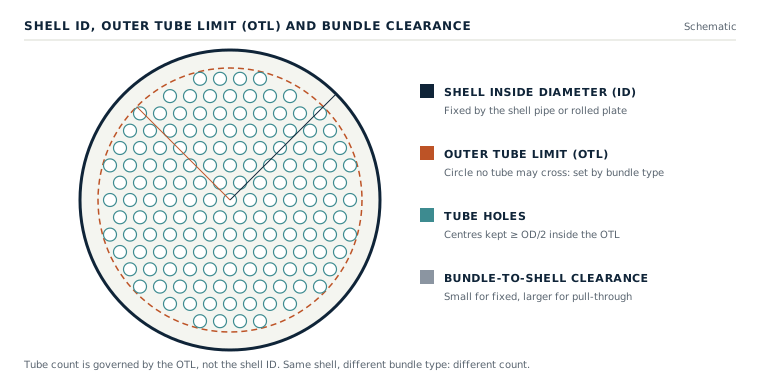
How much clearance depends on the bundle type. A fixed tube sheet unit can run tight, because nothing slides. A floating head bundle needs room for the floating head and its backing device, and a pull-through floating head (TEMA type T) needs the most. That is why two exchangers with the same shell can carry quite different tube counts. If the type letters are unfamiliar, our guide to TEMA heat exchanger types decodes them.
The four layout angles
TEMA recognises four tube layout angles, measured against the direction of shell-side flow.
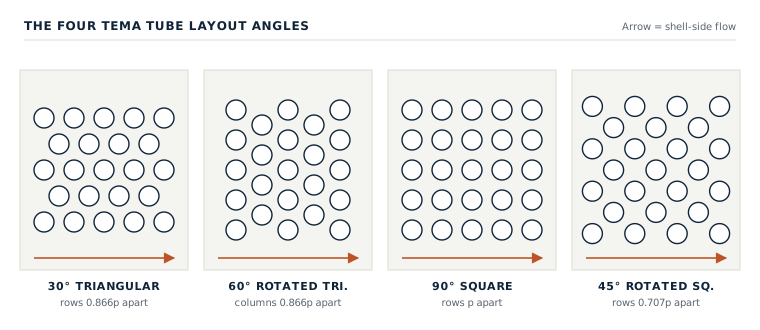
| Layout | Row spacing | Best for | Watch out for |
|---|---|---|---|
| 30° triangular | 0.866 × pitch | Clean services, maximum tubes per shell | No straight lanes for mechanical cleaning |
| 60° rotated triangular | 0.866 × pitch (columns) | Similar density, different flow path | Same cleaning limitation |
| 90° square | 1.0 × pitch | Fouling services cleaned with rods or brushes | Fewer tubes; lower shell-side turbulence |
| 45° rotated square | 0.707 × pitch | Cleanable bundles with better shell-side heat transfer | Fewer tubes than triangular |
Inside a plain circle with one pass, a pattern and its rotated version hold essentially the same number of tubes; rotation matters once pass lanes, tie rods and flow direction come in. For a side-by-side discussion see triangular vs square pitch.
Estimated tube count tables
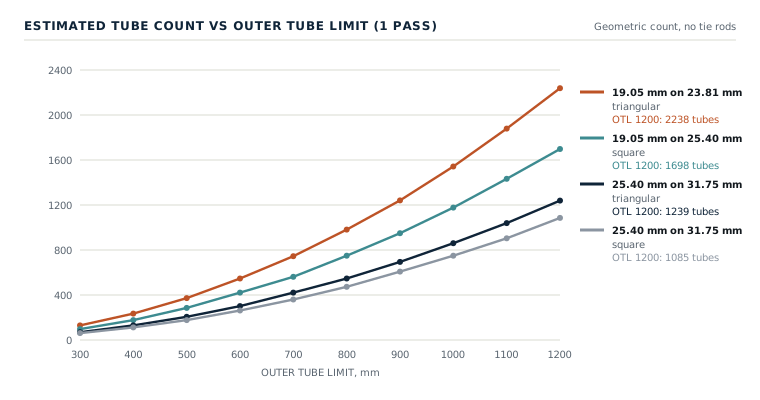
We computed these counts geometrically: a tube is counted when its centre lies at least half a tube OD inside the OTL. Single pass, no tie rods, no impingement plate, best of a few grid offsets. Real layouts lose some tubes to tie rods and spacers, so treat these as an upper bound for screening.
| OTL, mm | 19.05 on 23.81, 30° | 19.05 on 25.40, 90° | 25.40 on 31.75, 30° | 25.40 on 31.75, 90° |
|---|---|---|---|---|
| 300 | 130 | 97 | 69 | 61 |
| 400 | 235 | 177 | 130 | 112 |
| 500 | 372 | 285 | 206 | 177 |
| 600 | 547 | 421 | 301 | 262 |
| 700 | 745 | 562 | 421 | 360 |
| 800 | 981 | 749 | 547 | 473 |
| 900 | 1,241 | 949 | 694 | 608 |
| 1000 | 1,542 | 1,177 | 860 | 749 |
| 1100 | 1,879 | 1,433 | 1,039 | 904 |
| 1200 | 2,238 | 1,698 | 1,239 | 1,085 |
A quick formula to cross-check
For early sizing, a widely used estimate is N ≈ 0.785 × (CTP ÷ CL) × D² ÷ p², where D is the shell ID, p the pitch, CL the layout constant (0.866 for 30°/60°, 1.0 for 45°/90°) and CTP a tube-count constant for passes and clearance (about 0.93 for one pass, 0.90 for two, 0.85 for three).
Worked example: a 615 mm shell with 19.05 mm tubes on 23.81 mm triangular pitch gives N ≈ 0.785 × (0.93 ÷ 0.866) × 615² ÷ 23.81² ≈ 562 tubes. Our geometric count for a 600 mm OTL, which is that shell less a 15 mm clearance, is 547. Two independent methods landing within a few percent is the sign you're in the right range.
Pass lanes, tie rods and other tube thieves
Every pass partition plate in the channel needs a lane across the tube plate where no tubes can go. The more passes, the more lanes. Tie rods and spacers, impingement plates under the inlet nozzle, and U-bend clearances in U-tube bundles all take further positions.
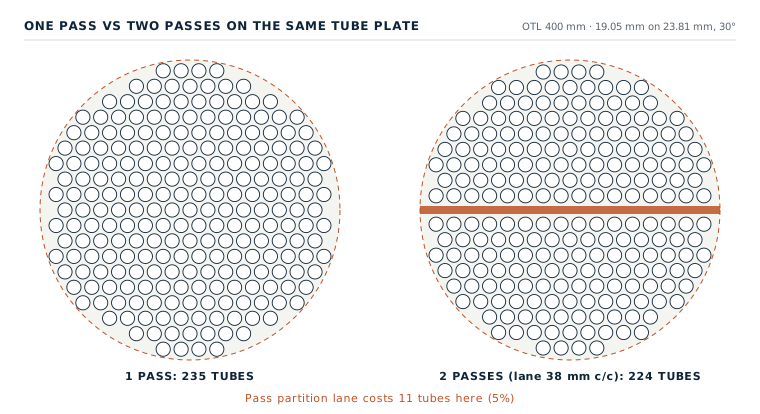
On the drawing, the pass partition lane shows up as a groove in the gasket face and a gap in the hole pattern. Our guide on how to read a tube sheet drawing shows where to find it.
Pitch, ligament and why they decide thickness
The ligament is the metal left between two neighbouring holes. It is what holds the tube plate together, so the design code checks it. Ligament efficiency is the ligament divided by the pitch.
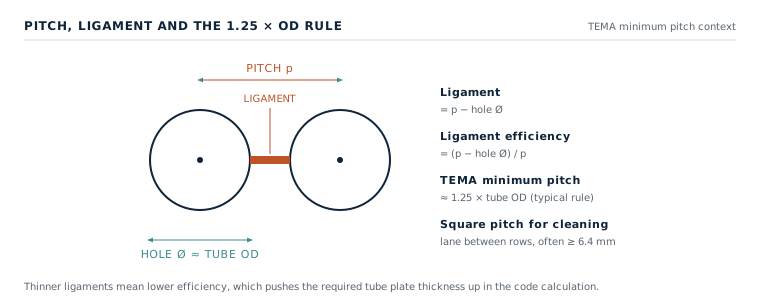
TEMA's usual minimum is a pitch of about 1.25 × tube OD, and square layouts for mechanical cleaning keep a lane between rows. Pack tubes closer and the ligament efficiency falls, which pushes the required tube plate thickness up in the ASME or TEMA calculation; see how tube sheet thickness is determined. Thick plates add one more catch: drilled holes can drift, so the ligament at the exit face may be narrower than drawn. Use the pitch calculator to check a pitch against the 1.25 rule.
Worked example: sizing a cooler tube plate
Say a process engineer needs about 500 tubes of 19.05 mm OD in a single-pass, fixed tube sheet cooler with a clean shell side. Here is how the numbers come together in practice.
- Pick the pattern. Clean shell side, no mechanical cleaning, so 30° triangular on 23.81 mm pitch (1.25 × OD).
- Find the OTL. From Table 2, 547 tubes fit a 600 mm OTL and 372 fit 500 mm. 600 mm gives headroom for tie rods.
- Subtract the extras. Six tie rods and an impingement plate under the inlet typically take out a few dozen positions, landing near the 500 target.
- Add clearance. A fixed tube sheet bundle needs only a small clearance, so a shell of roughly 610–620 mm ID works.
- Check the ligament. With a 19.3 mm hole on 23.81 mm pitch, the ligament is about 4.5 mm. Fine for a moderate thickness, but worth checking for hole drift on a thick tube plate.
Change one input and the answer moves. Switch to 25.40 mm square pitch for cleanability and the same 600 mm OTL holds about 421 tubes, so the shell has to grow to hit 500. That trade-off between cleaning access and shell size is the most common layout decision we see on RFQs.
Five layout mistakes that show up at quote stage
- Counting to the shell ID, not the OTL. It overstates the count, sometimes by 10% or more on small shells.
- Forgetting the pass lanes. A four-pass layout drawn as if it were one pass will not fit the channel partitions.
- Square pitch with no cleaning lane. If the bundle will be rodded, the lane between rows must be stated.
- Pitch below 1.25 × OD. It can be done, but it thins the ligament and usually needs a design justification.
- No reference hole on the drawing. Without it, the pattern can be machined correctly and still be in the wrong place.
Each one costs a round of questions before a tube plate can be quoted. Most are easy to catch with the checklist in our drawing guide.
From layout to a tube plate you can order
Once the layout is fixed, it becomes a hole table or a pitch-and-pattern note on the tube sheet drawing. To quote and machine it, we need:
- Tube OD, hole diameter and its tolerance class
- Pitch, layout angle and a reference hole
- Pass partition layout and groove dimensions
- Tie rod positions and thread size
- Material, thickness and any cladding
- Joint method: expanded, welded or both (see expanded vs welded)
Our CNC tube sheet drilling works directly from that data. The pitch and layout reference collects the common combinations in one place.
Frequently asked questions
With a 600 mm outer tube limit, 19.05 mm tubes on 23.81 mm triangular pitch fit about 547 tubes in a single pass, before tie rods. On 25.40 mm square pitch the same tubes fit about 421.
No. Tube plate is the usual UK, Indian and Australian term; tube sheet or tubesheet is the US and ASME term. The layout rules are the same.
In a triangular pattern each row is offset by half a pitch, so rows sit 0.866 × pitch apart instead of a full pitch. That packs about 15% more holes into the same area, and more once edge effects are counted.
TEMA typically requires a centre-to-centre pitch of at least 1.25 × tube OD. Square layouts that will be mechanically cleaned also keep a cleaning lane between rows.
They are good for screening and checking a design, usually within a few percent. The final count depends on tie rods, pass lanes, impingement protection and clearances on the actual drawing.
Sources and further reading
- TEMA, Standards of the Tubular Exchanger Manufacturers Association, tube pitch and layout requirements (RCB-2.5)
- R. W. Serth, Process Heat Transfer: Principles and Applications — tube count estimate with CTP and CL constants
- Tube counts in Table 2: NPRO India geometric calculation, November 2026