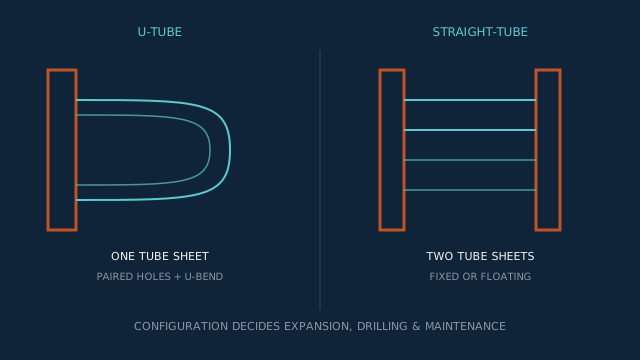
The configuration you freeze early — U-tube or straight-tube — shapes how the bundle accommodates differential thermal expansion, how the tube sheet is drilled, and how the exchanger will be cleaned and maintained over its life.
UPDATED 2026-09-0312 MIN READREVIEWED BY NPRO ENGINEERINGAUTHOR: NPRO EDITORIAL
When engineers say “U-tube versus straight-tube,” they are usually choosing how tubes return through the exchanger — and that choice shows up on the tube sheet.
In a U-tube arrangement, every tube bends into a U and both ends land in the same tube sheet. In a straight-tube arrangement, tubes run between two tube sheets (or a fixed sheet plus a floating sheet). That geometric difference affects thermal-expansion behaviour, hole-pair layout, cleaning access, tube replacement, and what belongs on a drawing-led RFQ.
This guide is for engineers, EPC writers, and procurement teams who specify tube sheets used in shell-and-tube heat exchangers, condensers, and boilers — not complete equipment manufacture. For design and inspection differences between boiler and HE tube sheets, see boiler vs heat exchanger tube sheets. NPRO India manufactures and exports tube sheets from India. Commercial specifications for the U-tube structural type live on the product page; this article owns the selection and comparison questions that sit in front of that RFQ.
U-Tube vs Straight-Tube Tube Sheets: Quick Comparison
What is the main difference? U-tube designs use one tube sheet with paired holes for each U-bend. Straight-tube designs use two tube-sheet faces (fixed–fixed, or fixed–floating) so each tube has a straight path between ends.
Dimension
U-tube tube sheet
Straight-tube (fixed or floating)
Configuration
Single tube sheet; tubes return to the same face
Two tube sheets (or fixed + floating assembly)
Tube path
U-bend return
Straight through
Thermal expansion
U-bend flexibility helps accommodate differential thermal expansion and reduces axial tube-to-shell restraint vs a fixed straight-tube design; shell expansion joints are often unnecessary for that differential
Fixed: shell expansion joint often required if ΔT is significant; Floating: axial movement absorbed at floating head
Tube-side cleaning / access
Limited near the bend; mechanical cleaning of U-bend ID is difficult
Generally better end-to-end mechanical access (especially floating)
Tube-sheet arrangement
One sheet at the bundle channel end for both tube ends
Two sheets; floating adds head hardware
Drilling / layout
Holes drilled in pairs; minimum bend radius constrains pitch and count
Holes map 1:1 tube to opposite sheet; denser packing often possible on fixed designs
Maintenance
Tube replacement near bend more complex; outer rows easier than inner
Straight tubes usually simpler to pull/replace
Typical selection drivers
Significant differential expansion; design temperature/pressure context; acceptable bend-side cleanability; geometry that still meets area requirements
Fouling needing full clean; maximum tube density (fixed); cleanability + expansion (floating)
Manufacturing notes
Single-sheet drilling; bend-radius geometry must be frozen before final pitch; U-bend fabrication and maintenance enter the lifecycle
Two sheets must match pattern; floating sheet adds machining/fit complexity
Take a position: Prefer U-tube when differential expansion and design conditions favour avoiding shell expansion joints or floating heads and fouling, tube-side cleanability, tube-replacement strategy, bend geometry, and project/code requirements still support that choice. Prefer straight-tube (especially floating) when mechanical cleaning and tube replaceability dominate lifecycle cost. Prefer fixed straight-tube when differential expansion is modest and tube density / cost matter most — then confirm whether a shell expansion joint is acceptable under the project design.
For product-level U-tube specs and drawing-led quotes, see U-tube tube sheets.
What Is a Tube Sheet?
A tube sheet is the perforated plate that separates shell-side and tube-side fluids and locates every tube at the pressure boundary. Holes, ligaments, face finish, grooves (where specified), and joint method (expanded, welded, or both) determine leak integrity and mechanical strength.
On NPRO’s site, tube sheets are organised as structural types (fixed, floating, U-tube), features (CNC machined, drilled, clad, forged, and related), and applications (heat exchanger, condenser, boiler, pressure vessel). This article focuses on structural configuration — that decision precedes material and often constrains drilling.
How U-Tube and Straight-Tube Configurations Differ
U-tube
One tube sheet.
Each tube has two ends in that sheet; the continuous tube forms a U-bend in the shell.
Bundle pull is typically from the channel end; shell-side access for cleaning is often available once the bundle is drawn, but the inside of the U-bend remains hard to mechanically clean or inspect.
Straight-tube
Tubes run between two tube sheets.
Fixed–fixed: both sheets rigid to the shell — highest tube density potential; significant differential expansion often needs a shell-side expansion joint. See fixed tube sheets.
Fixed–floating: one sheet free to move axially — differential expansion absorbed without a shell expansion joint; floating head hardware adds cost and complexity but improves cleaning access. See floating tube sheets.
Language note for RFQs: “Straight-tube tube sheet” is not a single NPRO product SKU. State fixed, floating, or U-tube explicitly so quotes are comparable.
Tube-Sheet Design Considerations
Before hole programming begins, design (or the approved drawing package) should freeze:
Structural type (U-tube / fixed / floating)
Tube OD, wall, material, and count
Pitch and layout (triangular, square, rotated square — as used in TEMA practice)
Pass partitions, untubed lanes, impingement zones
Finished hole diameter and tolerance for the joint method
Sheet diameter and thickness (calculated under the project’s code method — not guessed)
Facing, flatness, and any weld prep or grooves
Governing code package (commonly ASME Section VIII and/or Section I for boilers, plus TEMA class where the exchanger is TEMA-built)
NPRO reviews enquiries against governing code, material compatibility, and manufacturing feasibility before quoting. NPRO is not the design authority for a customer’s complete pressure-vessel or heat-exchanger design unless that scope is explicitly contracted; thickness and layout remain project-design responsibilities unless otherwise agreed.
Thermal Expansion and Mechanical Considerations
Differential thermal expansion between tubes and shell is a primary mechanical reason structural types exist.
U-tube: The U-bend provides flexibility that helps accommodate differential thermal expansion between the tubes and the shell and reduces axial restraint compared with a fixed straight-tube arrangement. In many designs this means a shell-side expansion joint or floating head is not required for that differential — but the bend itself adds manufacturing, inspection, and cleaning constraints.
Fixed straight-tube: Tubes and shell are more axially constrained together. Significant differential expansion usually means an expansion joint or another design accommodation.
Floating straight-tube: The floating end moves; differential expansion is handled mechanically at the head.
Trade-off: A U-tube arrangement can avoid certain shell-side expansion-joint or floating-head arrangements, while introducing its own U-bend manufacturing and maintenance considerations. Floating hardware improves cleanability — usually at higher fabrication cost and with more joints to manage for the same diameter/material class.
Metal temperatures, startup/shutdown transients, fouling regime, tube-replacement strategy, and code/project requirements decide which trade-off wins. Do not select U-tube solely because “it handles expansion” if the fluid will plug the bends.
Tube-Hole Layout, Pitch and Ligament Considerations
Hole layout is where U-tube geometry becomes a drilling problem, not only a thermal one.
Pitch sets ligament width (material between holes). Ligaments carry pressure loads; they also limit how aggressively a tube can be expanded.
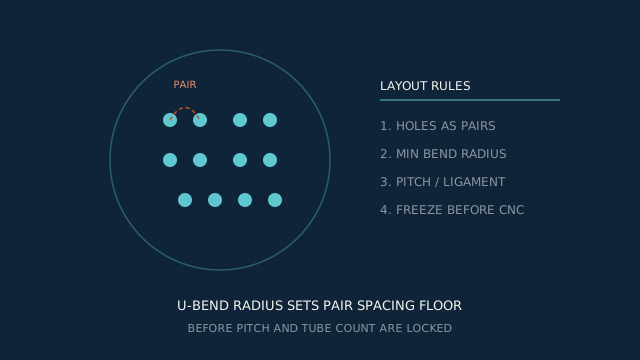
U-bend minimum radius for a given tube OD sets a practical floor on how close adjacent U-bend pairs can sit. That changes tube count and pitch optimisation versus a straight-tube map of the same shell diameter.
Untubed lanes, baffle clearances, and pass-partition lands must appear in the hole table. Missing exceptions scrap plates.
For U-tube sheets, the programme must treat hole pairs as a geometric unit — not two unrelated holes.
Bend radius sets a floor on pair spacing before CNC programming.
Early layout checks (pitch rules, approximate tube count) help buyers sanity-check drawings before RFQ; the released drawing revision remains the manufacturing authority.
CNC Drilling and Tube-Hole Accuracy
CNC drilling matters when positional consistency across high hole counts, thick plates, clad constructions, or tight joint fits cannot rely on ad-hoc layout.
On a commercial RFQ, “drilling” typically includes:
Locating every hole from agreed datums
Controlling finished diameter for tube fit-up
Holding pitch/position across the pattern
Leaving bore condition suitable for expand/weld
Controlling burrs, tear-out, and clad discontinuity at hole walls
Inspection records linked to the blank
Deep drilling through thick sections raises chip evacuation, wander, and surface-condition risks — these belong in acceptance criteria, not as afterthoughts.
For drawing-led CNC tube sheet drilling job work and RFQ fields, see NPRO’s CNC tube sheet drilling services. Process education (patterns, accuracy drivers) already lives in the CNC journal article; this article does not retell that process end-to-end.
U-tube-specific drilling note: Freeze bend radius and pair spacing before locking the CNC programme. Changing bend radius after programming can invalidate pitch and count.
Materials and Service Conditions
Material follows fluid chemistry, temperature, and code allowable stress — not the structural type alone. U-tube configurations often appear on high-duty boiler and process RFQs; NPRO’s U-tube product page frames alloy steel, elevated-temperature stainless (including stabilized grades such as 321 where specified), and Inconel among materials seen on that structural type. Those are starting points from the live product page — not a claim that every U-tube order uses those grades.
Straight-tube condenser or seawater-adjacent duties may push other families (for example copper-nickel or duplex) for corrosion reasons. Those choices sit on top of fixed/floating/U-tube selection and must follow the project corrosion specification.
Do not copy a grade from a previous plant without verifying chemistry and temperature.
Maintenance and Inspection Considerations
Topic
U-tube
Straight-tube
Mechanical tube-side cleaning
Restricted at bend
Typically better
Individual tube replacement
Possible but harder near bend; outer rows easier
Usually simpler
Shell-side access
Bundle pull often allows shell-side cleaning
Depends on rear-head / floating design
Inspection of bend ID
Limited
N/A (no U-bend)
Hardware to maintain
No floating head
Floating adds joints/gaskets to manage
If the inspection plan requires periodic mechanical cleaning of every tube ID, U-tube is usually the wrong structural answer — even when differential expansion looks attractive on paper.
When Should You Choose a U-Tube Configuration?
Choose U-tube when most of the following align — not when pressure or temperature alone look “high”:
Differential thermal expansion between tubes and shell is significant under the design conditions.
Avoiding a shell-side expansion joint or floating-head arrangement is desirable for the project’s mechanical design.
Fouling is moderate enough that limited bend-side mechanical cleanability is acceptable (or chemical cleaning is planned).
Tube-replacement strategy accepts more complex work near the bend.
Bend-radius and pair geometry still allow the required heat-transfer area in the shell diameter.
Project design and code requirements support the configuration.
Boiler and high-ΔT process packages often land here — only after fouling, cleanability, geometry, and code checks.
When Is a Straight-Tube Arrangement More Appropriate?
Choose straight-tube when most of the following are true:
Tube-side or shell-side fouling requires full mechanical cleaning.
Frequent individual tube replacement is expected.
Maximum tube count / density in a given diameter is critical (fixed).
Differential expansion is significant and full cleanability is mandatory (floating).
The project standardises on TEMA rear-head types that assume straight tubes.
When both expansion relief and full mechanical cleaning are required, floating straight-tube is often the better fit than U-tube — usually at higher hardware cost. NPRO’s floating product guidance contrasts cleanability-driven floating selection with U-tube selection for demanding thermal/pressure packages; treat that as a starting trade-off, not a universal rule.
Fixed vs Floating Tube Sheets: Where They Fit
Straight-tube is a family, not a single design.
Fixed: dense and economical when differential expansion is modest — expansion-joint risk rises as ΔT rises.
Floating: differential expansion plus cleanability — more parts, usually higher cost.
U-tube: differential expansion without a floating head — cleanability and replacement penalties at the bend.
A fixed-vs-floating compare page already exists on the site. Use it for a quick two-way table; use this article when U-tube and drilling/RFQ consequences must sit in the same decision.
What to Include in a Tube Sheet RFQ
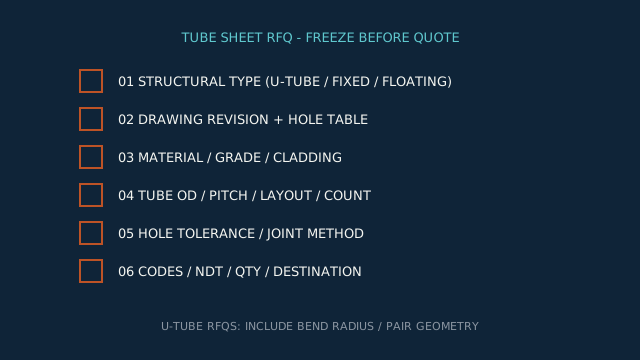
Freeze type, geometry, and code before quote.
Send enough for a manufacturable, comparable quote:
Structural type: U-tube / fixed / floating
Released drawing revision (PDF + editable if available)
Material / grade and any cladding
Finished diameter and thickness (or design inputs if thickness is TBD)
You do not need a perfect thickness number to start — you do need enough geometry and code context for manufacturability review.
Common Tube Sheet Specification Mistakes
Writing “straight tube sheet” without saying fixed or floating.
Freezing pitch before U-bend radius (or changing bend radius after CNC programming).
Omitting untubed lanes / pass partitions from the hole table.
Copying thickness from an old job without current pressure/pitch.
Specifying U-tube into heavily fouling service because “it handles expansion.”
Selecting U-tube from pressure or temperature alone without fouling, cleanability, geometry, and code checks.
Asking for catalogue pitch instead of released coordinates.
Leaving joint method blank — expand vs weld changes hole finish and tolerance.
Mixing TEMA pitch definitions between notes and the hole table.
Assuming one code automatically governs every project.
Treating the tube-sheet fabricator as the complete exchanger designer without a design contract.
How NPRO Approaches Tube Sheet Manufacturing / Drilling
NPRO India is a Mumbai-based tube sheet manufacturer, supplier, and exporter. Enquiries are reviewed for code alignment, material compatibility, and manufacturing feasibility before a commercial offer is locked — including ligament and CNC reach checks where drilling is in scope.
After this comparison, open the matching commercial destination: U-tube product specifications for U-tube RFQs; fixed or floating product pages for straight-tube structural types; and the CNC drilling services page when the scope is drawing-led hole patterning.
Buyers specifying ASME/TEMA packages for international projects can review NPRO’s export context for the United States and Canada. Singapore-based procurement coordinating Asia-bound packages may also find NPRO’s Singapore export page useful; it is not required reading for every RFQ.
Typical diameter/thickness framing on the live U-tube product page (confirm per order): about 150–2200 mm diameter and 20–200 mm thickness for high-pressure services. Treat as reference ranges from that page — not catalogue stock.
FAQ
What is the main difference between U-tube and straight-tube arrangements?
U-tube uses one tube sheet with paired holes and a U-bend return. Straight-tube uses two tube sheets (fixed or floating) so tubes run end-to-end.
When is a U-tube configuration advantageous?
When differential thermal expansion and design conditions favour avoiding shell expansion joints or floating heads, and fouling, tube-side cleanability, tube-replacement strategy, bend geometry, and project/code requirements still support the choice. Pressure or temperature alone is not enough.
When should I choose floating instead of U-tube if both address expansion?
When mechanical cleaning access and easier tube replacement matter more than avoiding floating-head hardware — common in fouling services.
Does U-bend radius affect tube-sheet drilling?
Yes. Minimum bend radius constrains how close hole pairs can sit, which changes pitch, tube count, and the CNC programme versus a straight-tube layout.
What information is needed to manufacture a tube sheet?
At minimum: structural type, material/grade, drawing revision, tube OD/pitch/layout, hole diameter/tolerance, joint method, thickness or design inputs, codes/NDT, quantity, and destination. U-tube RFQs should include bend/pair geometry.
Are U-tube tube sheets always governed by the same standard?
No. Requirements depend on equipment design, jurisdiction, purchaser specification, and pressure-boundary classification. Many projects cite ASME Section VIII and/or Section I with TEMA class where applicable; UK/EU-bound equipment may involve EN 13445 / PED packages — confirm on the project.
Can NPRO drill only the hole pattern if the blank is free-issued?
Drawing-led CNC tube sheet drilling / job work is offered commercially; capability for a specific diameter, thickness, and alloy is confirmed against the drawing at enquiry — see the CNC drilling service page.
Does NPRO manufacture complete heat exchangers or boilers?
NPRO’s published scope centres on tube sheets (and related machining/drilling). Application pages describe tube sheets for heat exchangers, condensers, and boilers — not complete equipment manufacture unless separately stated on the live site.
Freeze the Configuration, Then RFQ
U-tube versus straight-tube is a mechanical decision: differential expansion, cleanability, hole-pair geometry, lifecycle maintenance, and code/project constraints. Freeze it before CNC programming and quotation.
Specifying a U-tube sheet: open the commercial product page and send a drawing-led RFQ. Still choosing among fixed, floating, and U-tube: use this comparison, then open the matching product page.
Written by the NPRO India editorial team with technical review by our tube-sheet engineering group in Mumbai. Guidance reflects TEMA / ASME practice and real RFQ patterns from EPC and OEM buyers. For project-specific advice, contact sales@nproindia.in or +91 9594639793.