What typically changes in design drivers, material emphasis and inspection packages — confirmed on the project documents, not assumed from the label.
UPDATED 2026-10-0412 MIN READREVIEWED BY NPRO ENGINEERINGAUTHOR: NPRO EDITORIAL
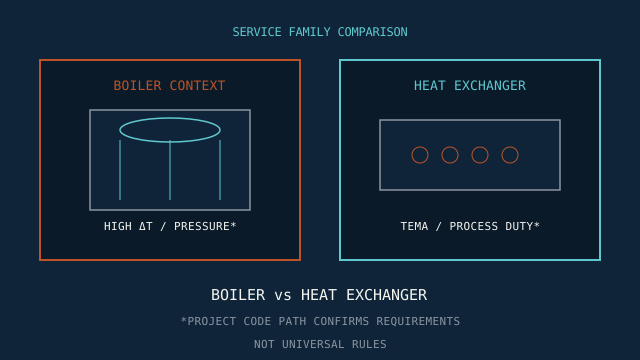
Boiler tube sheets and heat-exchanger tube sheets often look similar in photographs — thick drilled discs holding tubes — but the design drivers, material emphasis, and inspection packages can differ because the equipment families and Code contexts differ. Treating “boiler” and “heat exchanger” as interchangeable labels on an RFQ produces wrong assumptions about joints, expansion provisions, and documentation.
This article compares what typically changes across those service families. It does not claim that boilers always require one grade, one joint, or one NDT suite, nor that every heat exchanger follows TEMA the same way. Confirm the project Code package, drawing, and purchaser specification. For HE product classification context see heat exchanger tube sheets; for structural types see tube sheets overview and U-tube vs straight-tube.
Quick answer: Boiler duty often emphasises high temperature/pressure, steam/water chemistry, and boiler-code or IBR paths where applicable. Heat-exchanger duty emphasises process fluid pairs, TEMA/ASME VIII-oriented packages where specified, and a wider mix of fixed/floating/U-tube layouts. Materials and inspection follow the project documents — not a universal boiler-vs-HE checklist.
Figure 1 — Tendencies for discussion; project documents govern.
Same component idea, different package
Both boiler and heat-exchanger tube sheets are precision-drilled pressure-boundary parts that locate tubes and separate fluids. The temptation is to reuse a prior RFQ template and change only the tag number. Resist that. The package around the disc — Code references, expansion story, cleaning philosophy, inspector involvement — is what changes more often than the existence of holes.
Readers coming from the commercial heat exchanger tube sheets page should treat that page as an application gateway, not as proof that every drilled sheet is “HE duty.” Boiler work may share suppliers and machine shops with HE work while still needing different document control. Country and market pages do not override Code applicability either.
Design — what often changes
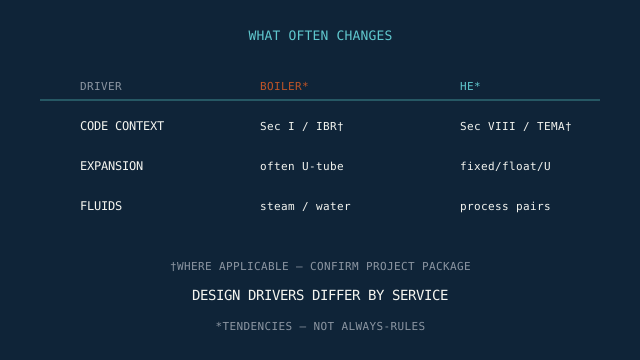
Code / construction context: Boiler equipment may sit under boiler Code paths (for example ASME Section I context where applicable) and, for Indian boiler duty, IBR considerations where they apply. Shell-and-tube heat exchangers frequently reference ASME Section VIII and TEMA class practice when those are in the project package. Naming a Code here is educational orientation — the purchase order and drawing name the governing editions.
Thermal expansion: Boilers with large temperature swings often favour U-tube layouts that accommodate differential expansion with a single tube sheet; that is a common pattern, not a mandate. Heat exchangers may use fixed, floating-head, or U-tube arrangements depending on ΔT, cleaning needs, and leakage risk. See the U-tube vs straight-tube article for layout tradeoffs.
Fluids and fouling: Boiler sides are typically steam/water chemistry problems (carryover, oxygen, pH control). HE duty spans hydrocarbons, acids, brines, cooling water, and more — driving gasket, clad, and cleaning access decisions that may not appear on a boiler sheet of similar diameter.
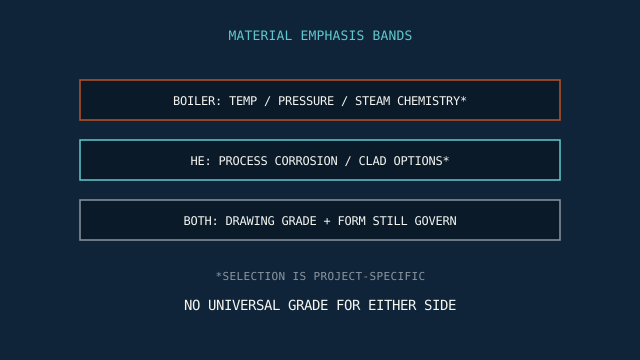
Boiler-oriented selections often prioritise elevated-temperature strength, steam-side oxidation/corrosion behaviour, and grades familiar to boiler designers (including alloy and stainless paths where the calculation requires them). HE selections more often optimise for process corrosion, chloride resistance, or clad economics on one face — see clad vs solid and material family guides.
Neither side has a single correct alloy. “Boiler = alloy steel always” and “HE = 316L always” are both false. Freeze grade, UNS, product form, and cladding on the drawing. Product form (plate vs forge) follows forged vs rolled plate logic on either service family.
Joints, retubing, and lifecycle
Tube-to-tubesheet joints — expanded, welded, or hybrid — appear in both families, but retubing frequency and access differ. Some boiler services plan for retube cycles; some process exchangers are designed as clean-in-place with rare tube pulls. That lifecycle changes how much abuse holes must tolerate and whether repairability is a design goal. Joint mechanics are covered in expanded vs welded; in-service hole damage response is covered in damaged tube sheet holes.
Floating-head HE designs introduce rear sheets and backing devices that boiler U-tube layouts may not have. Fixed tubesheet HEs raise shell-side differential expansion issues that boiler U-tube bundles avoid differently. Name the structural type on the RFQ so vendors do not assume a single-sheet U-tube blank for a two-sheet fixed design.
Inspection — what often changes
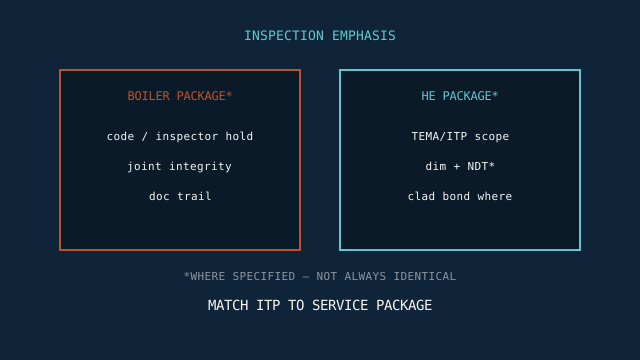
Figure 3 — Match the ITP to the service package; do not copy blindly.
Boiler packages may emphasise authorised inspector hold points, joint integrity demonstrations, and documentation trails required by the boiler Code/IBR path that applies. HE packages may emphasise TEMA/ITP dimensional sampling, PMI/NDT where specified, and clad-bond examination when cladding is used. Overlap exists — dimensional accuracy and material traceability matter in both — but the checklist is not identical by default.
Do not copy a condenser ITP onto a boiler retubing job (or the reverse) without review. New-build sequencing discipline is summarised under testing & quality; dimensional families still follow tube sheet tolerances explained. Service-family differences change which hold points appear, not the need for revision control.
Documentation packages
Expect document lists to differ even when hole patterns look alike. Boiler packages may request inspector sign-offs, specific data report forms, and material certificates aligned to boiler Code clauses that apply. HE packages may request TEMA-oriented dimensional reports, PMI logs where specified, clad bond UT where cladding exists, and ITP countersignatures from EPC quality teams.
Neither list is a stereotype you should invent for the vendor. Attach the project’s required document matrix. If none exists yet, ask engineering to issue one before competitive bidding — otherwise each bidder will assume a different burden and price it differently, recreating the incomparable-quote problem described in RFQ mistakes.
Country of installation can add regulatory overlays (for example PED for certain EU market equipment, or IBR for applicable Indian boilers). Overlays add paperwork; they do not by themselves pick tube sheet thickness or grade.
RFQ language that prevents mix-ups
Name the equipment type and tag (boiler, condenser, process HE, etc.).
Cite governing Code/standard editions and TEMA class if applicable.
State structural type (fixed / floating / U-tube) and joint method.
Freeze material, form, and clad notes.
Attach the tube sheet drawing revision — not a photo of an old sheet alone.
Procurement checklists in ten questions and RFQ mistakes still apply; add service-family clarity on top.
TEMA classes — HE service class context when TEMA is cited.
IBR — confirm applicability for Indian boiler duty with the project’s authorised path; do not assume every export boiler uses IBR.
NPRO supplies drawing-led tube sheets for heat-exchanger and related process equipment contexts described on our product pages. We do not invent Code applicability for your jurisdiction — engineering on the project decides.
Worked contrasts (illustrative only)
Contrast A — Utility boiler U-tube sheet vs refining shell-and-tube floating head: The boiler job may emphasise elevated-temperature material allowables, single-sheet U-bend clearance, and boiler inspector documentation. The refining floating-head job may emphasise hydrocarbon-side cladding or overlay, TEMA R-oriented robustness where specified, and bundle-pull maintenance access. Same vendor capability envelope might serve both; the drawings will not look the same.
Contrast B — Condenser HE vs small packaged boiler: Condenser sheets often chase large hole counts, tight positional control, and cooling-water chemistry (Cu-Ni or titanium paths in some plants). A small packaged boiler sheet may be smaller, thicker relative to diameter, and governed by a boiler package with different inspection witnesses. Hole-count bravado does not transfer.
These contrasts are teaching tools. Your project may invert them. The discipline is to read the package, not the nickname.
Buyer checklist
Equipment family and tag stated?
Governing Code/standards/editions listed?
Structural type and joint method explicit?
Material, form, clad notes complete?
ITP/inspection hold points attached or referenced?
Expansion and cleaning philosophy understood by vendors?
Reusing an HE TEMA checklist for boiler Code work without reconciliation.
Material copy-paste from a prior plant without chemistry review.
Ignoring expansion provisions when ΔT differs between services.
Ordering from a photo without a controlled drawing revision.
FAQ
Are boiler and heat exchanger tube sheets the same part?
They share the same component idea but often differ in Code context, expansion layout, materials emphasis and inspection package. The drawing and project specification define the actual requirements.
Do boilers always need U-tube sheets?
No. U-tube is common where expansion and layout favour it, but it is not a universal rule.
Does every heat exchanger require TEMA?
No. TEMA applies when the project cites it. Other packages may govern.
Is IBR always required for boiler tube sheets?
IBR considerations apply where Indian boiler regulations cover the equipment. Export and non-IBR contexts differ — confirm on the project.
Can the same material be used for both?
Sometimes, if the design allowables and corrosion review support it. Never assume sameness from the alloy nickname alone.
What should the RFQ state first?
Equipment type/tag, governing Code/standards, structural type, material/form and the tube sheet drawing revision.
About the author / EEAT
Written by the NPRO India editorial team with technical review by our tube-sheet engineering group in Mumbai. Guidance reflects drawing-led manufacturing practice and TEMA / ASME thinking used on EPC and OEM enquiries. For project-specific advice, contact sales@nproindia.in or +91 9594639793.