NPRO Journal · MANUFACTURING
Forged vs Rolled
Plate Tube Sheets
Which blank route fits your duty — forged or rolled plate — and what to freeze on the RFQ before anyone cuts metal.
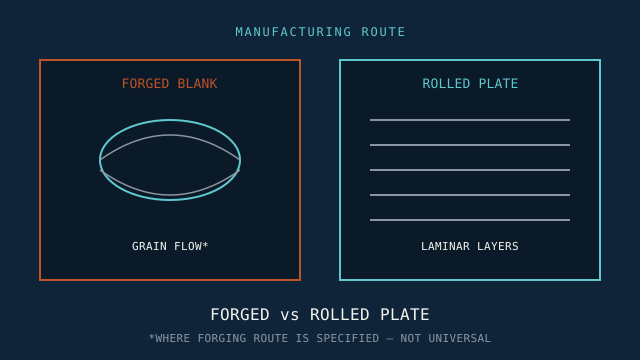
Which blank route fits your duty — forged or rolled plate — and what to freeze on the RFQ before anyone cuts metal.
Tube sheets begin life as either a rolled plate blank cut from plate stock or a forged blank produced to a forging specification — then machined and drilled to the released drawing. The manufacturing route is not a branding preference. It is a product-form decision that affects available thickness and diameter, mechanical-property tables, lead time, cost, and which ASTM (or equivalent) callout belongs on the purchase order.
This article helps procurement and project engineers decide which route fits an application — and what to freeze on the RFQ — without treating forge as automatically superior to plate. It complements the commercial overview on forged tube sheets and does not replace material selection guidance in how to select tube sheet material. For thickness drivers that exist on either route, see how tube sheet thickness is determined. For the wider heat exchanger tube sheet guide (types, materials, codes, RFQ), use the hub page.
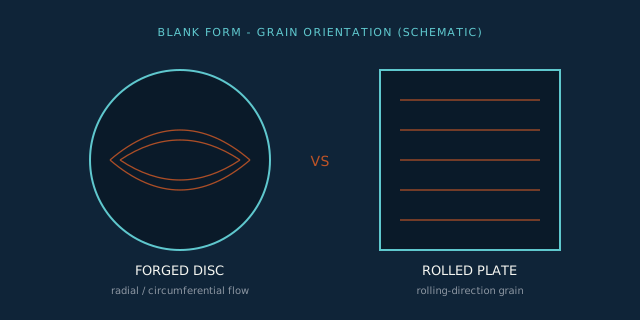
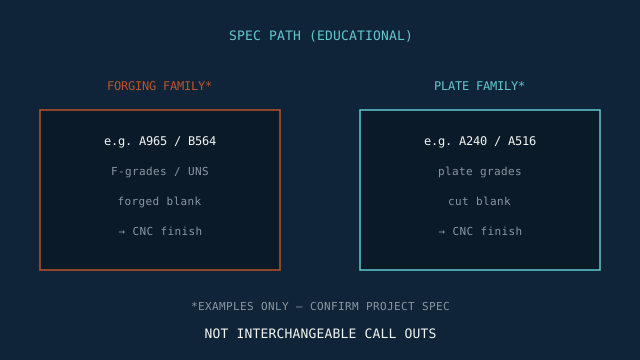
Rolled plate starts as mill plate produced to a plate specification (for example stainless plate families such as ASTM A240 grades, or carbon plate families such as A516 where applicable). The blank is cut — typically by waterjet, plasma, or saw — then faced, feature-machined, and drilled. Grain structure reflects rolling; through-thickness properties and ultrasonic testing expectations follow the plate specification and any supplementary requirements on the order.
Forged blanks are produced at a forge house to a forging specification (for example austenitic stainless forgings under ASTM A965 / SA-965 F-grades, or nickel-alloy forgings under ASTM B564 where listed). The blank arrives near net diameter and thickness for subsequent CNC facing, features, and hole patterns. Directional grain flow and refined structure are attributes of the forging process as reflected in the applicable forging specification — not a blanket claim that every forged blank outranks every plate blank of the same alloy name.
Both routes still require the same drawing-led finish: thickness, faces, grooves, and hole pattern per revision. Route choice changes the blank path and the material certificate language, not the need for accurate CNC drilling and feature machining.
Rolled plate is often appropriate when:
Plate is not “commodity” by default. Thick plate, clad plate, and exotic alloys still need careful facing, clad protection, and inspection where specified. Clad constructions often use a plate or clad-plate path; see clad vs solid tube sheets for bond and NDT context. Availability at thickness is the practical limiter — if plate cannot be sourced at the required size, engineering may revise to a forging path or change dimensions.
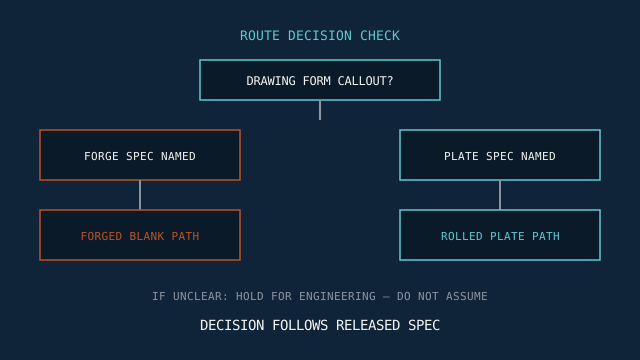
Forging routes appear when drawings or material packages call for a forging specification, or when plate is not available at the needed thickness/diameter for the alloy. Typical drivers include:
Allowable-stress benefit is not automatic. Designers use the values and notes that apply to the chosen product form and Code edition. Do not substitute a forging callout for a plate callout (or the reverse) without engineering authority — the specifications are not interchangeable. The commercial page on forged tube sheets summarises form intent; this article focuses on the application decision.
Use scenarios as discussion aids, not automatic selection rules:
Export packages add documentation expectations (EN material standards, PED context for EU market equipment, client specs). Form callouts must still be explicit — a PED-bound HE does not automatically require forging, and a boiler package does not automatically forbid plate. Confirm on the project file, using standards guidance as orientation only.
Mill test certificates and material test reports cite the specification that was ordered. A plate MTC for ASTM A240 Type 316L is not evidence of compliance with an A965 F316L forging order, even when the UNS number aligns. Receiving inspection should reject silent form swaps. Dual certification is only valuable when both listed specifications are actually applicable to the product form supplied — not when a vendor stamps extra lines for convenience.
Traceability from heat lot through blank cutting or forging, to CNC and final inspection, should be reconstructable when the purchase specification requires it. That trail is part of route discipline: forge houses, plate processors, and machine shops each add links. Ask for the blank route narrative during quote clarification if the critical path is unclear — related scheduling themes appear in lead times.
What can change with route:
What does not change:
Integrity after drilling — ligament remaining, clad wall condition, face flatness — is a machining and inspection outcome on either blank type. See how tube sheet thickness is determined for ligament and strength context, tube sheet tolerances explained for flatness/position/diameter language, and CNC tube sheet drilling for faces, grooves and hole-pattern execution.
Forged blanks are frequently made to order at a forge house before machining begins, so the forge step often sits on the critical path. Plate blanks may ship faster when stock plate exists at size — but thick or exotic plate can also have long mill lead times. Quotes that ignore blank form will not be comparable.
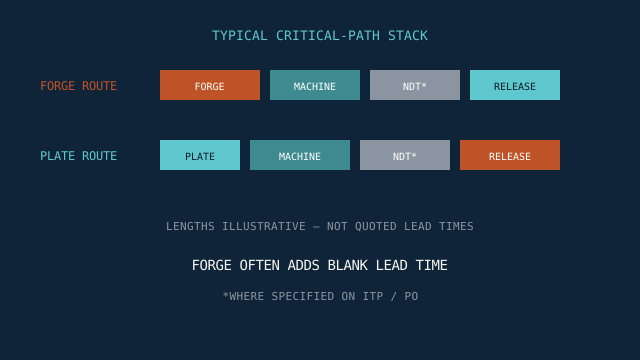
Cost drivers include forge weight and heat, alloy premium, machining hours, cladding, and NDT hold points where specified. A cheaper plate quote that does not meet a forging callout on the drawing is not a valid substitute. For how queues and hold points move schedules, see why lead times differ.
Once the blank is on the machine, route differences shrink to stock allowance, residual stress behaviour, and certificate paperwork. Facing establishes thickness; grooves and gasket lands follow the feature set on the revision; holes follow the pattern. Deep-drilling risk, chip evacuation, pitch accuracy, feature sequencing and datums are process topics covered in CNC tube sheet drilling — they apply to both plate and forged blanks. Product-level machining context also sits on CNC machined tube sheets.
Residual stress relief, if required by material specification or purchaser note, must be planned before final dimensional acceptance. Do not assume every stainless plate needs the same PWHT story as every forged alloy — follow the documents. Clad blanks need extra care so facing does not consume minimum clad thickness on the process face.
Freeze these fields so vendors quote the same product form:
If the drawing says “SS316L” without form, ask engineering which specification path applies before RFQ. Ambiguous form is a classic cause of incomparable bids — see RFQ mistakes and ten questions before ordering.
NPRO India manufactures and supplies tube sheets from Mumbai with engineering review on enquiries — CNC machining, drilling, and drawing-led finishing on the blank form specified for the order. When a forging route is required, the forged blank is sourced to the applicable forging specification; this article does not claim that NPRO operates a forging plant, publish a capacity envelope, or invent forge certifications.
Share the revision early via tube sheet manufacturer in India or the enquiry path so form, size, and machinability are confirmed together. Capability remains job-specific: diameter, thickness, material, and equipment available for that enquiry.
If three or more answers are “unclear,” stop and raise an engineering query before RFQ. Ambiguity is cheaper to fix on paper than after a forge die is cut or thick plate is purchased.
No. Forging is specified when the drawing, code path, geometry or availability requires that product form. Plate is appropriate when the approved specification is a plate path and size is available. “Better” is project-specific.
Only with engineering and purchaser authority. Plate and forging specifications are not interchangeable callouts.
NPRO machines and supplies tube sheets to drawing. When a forging route is ordered, forged blanks are sourced to the applicable forging specification — this article does not claim NPRO owns a forge facility.
State the material specification, grade/UNS, and product form (plate vs forging) on the same revision referenced in the enquiry.
Integral hubs and certain geometries are often produced from forged blanks when the design calls for them — confirm on the drawing rather than assuming.
Not automatically. Designers use the allowables and notes for the chosen product form and Code edition.
Include plate vs forging specification, revision, and finished size so quotes match the same manufacturing path.
Send an Enquiry →